EX-99.1
Published on May 6, 2026
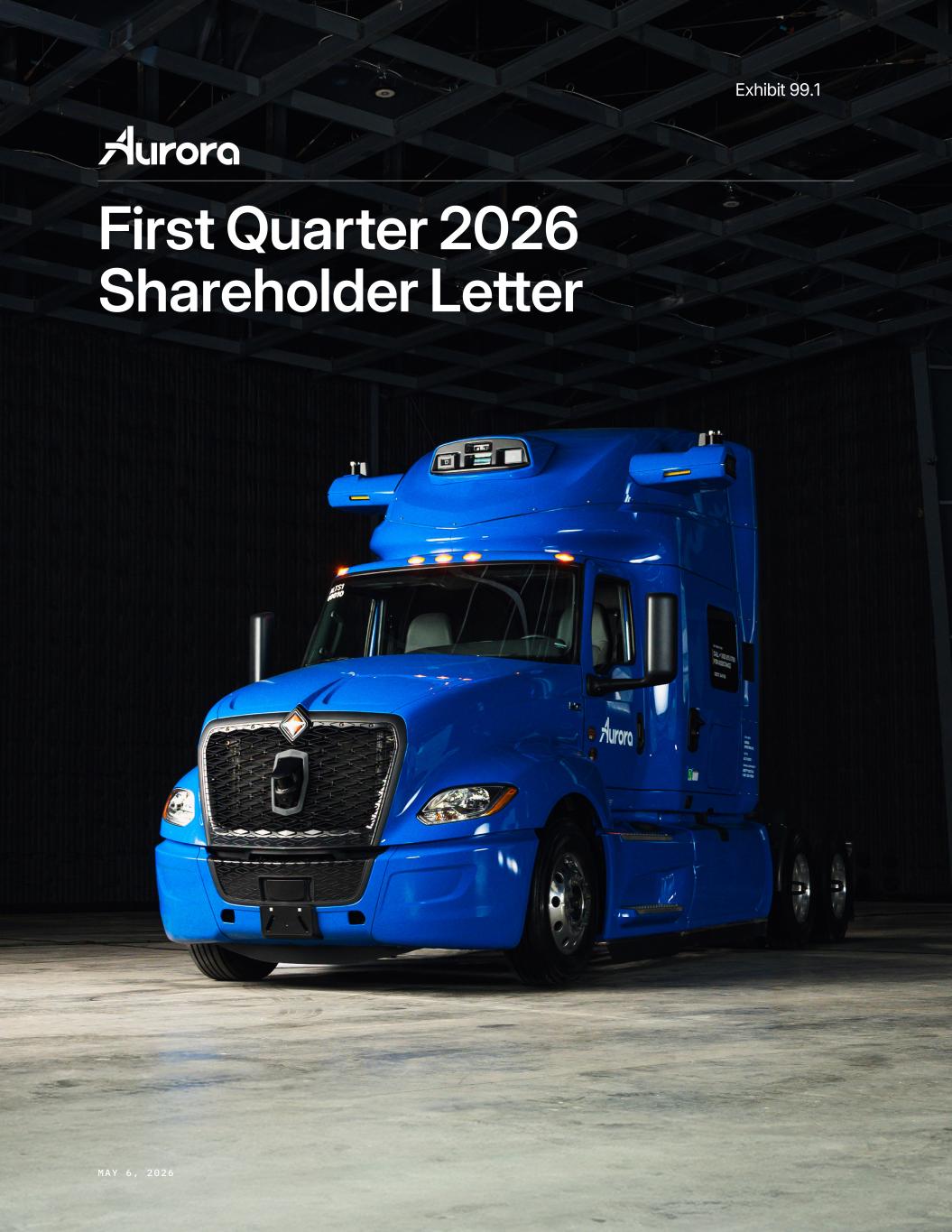
First Quarter 2026 Shareholder Letter MAY 6, 2026 Exhibit 99.1
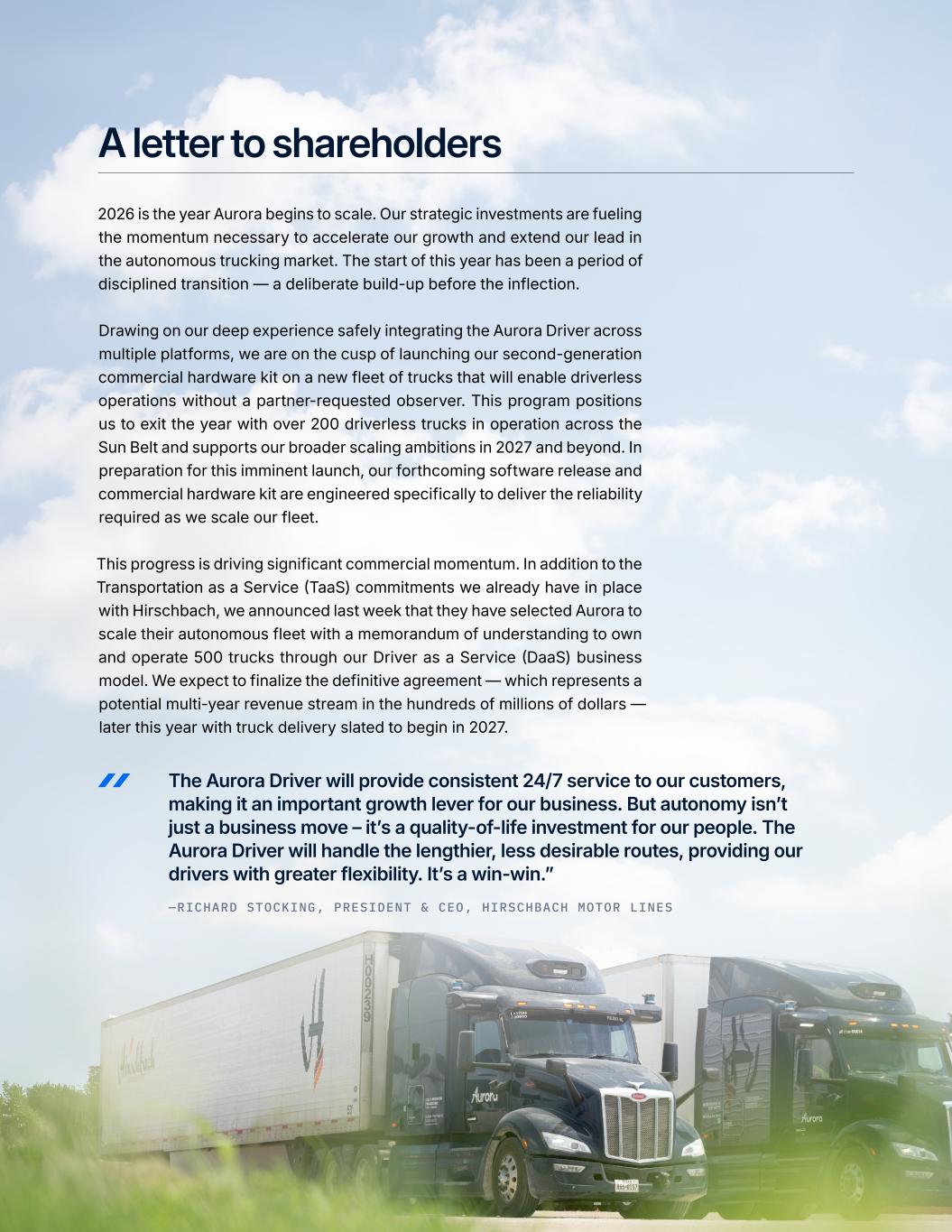
A letter to shareholders 2026 is the year Aurora begins to scale. Our strategic investments are fueling the momentum necessary to accelerate our growth and extend our lead in the autonomous trucking market. The start of this year has been a period of disciplined transition — a deliberate build-up before the inflection. Drawing on our deep experience safely integrating the Aurora Driver across multiple platforms, we are on the cusp of launching our second-generation commercial hardware kit on a new fleet of trucks that will enable driverless operations without a partner-requested observer. This program positions us to exit the year with over 200 driverless trucks in operation across the Sun Belt and supports our broader scaling ambitions in 2027 and beyond. In preparation for this imminent launch, our forthcoming software release and commercial hardware kit are engineered specifically to deliver the reliability required as we scale our fleet. This progress is driving significant commercial momentum. In addition to the Transportation as a Service (TaaS) commitments we already have in place with Hirschbach, we announced last week that they have selected Aurora to scale their autonomous fleet with a memorandum of understanding to own and operate 500 trucks through our Driver as a Service (DaaS) business model. We expect to finalize the definitive agreement — which represents a potential multi-year revenue stream in the hundreds of millions of dollars — later this year with truck delivery slated to begin in 2027. The Aurora Driver will provide consistent 24/7 service to our customers, making it an important growth lever for our business. But autonomy isn’t just a business move – it’s a quality-of-life investment for our people. The Aurora Driver will handle the lengthier, less desirable routes, providing our drivers with greater flexibility. It’s a win-win.” —RICHARD STOCKING, PRESIDENT & CEO, HIRSCHBACH MOTOR LINES
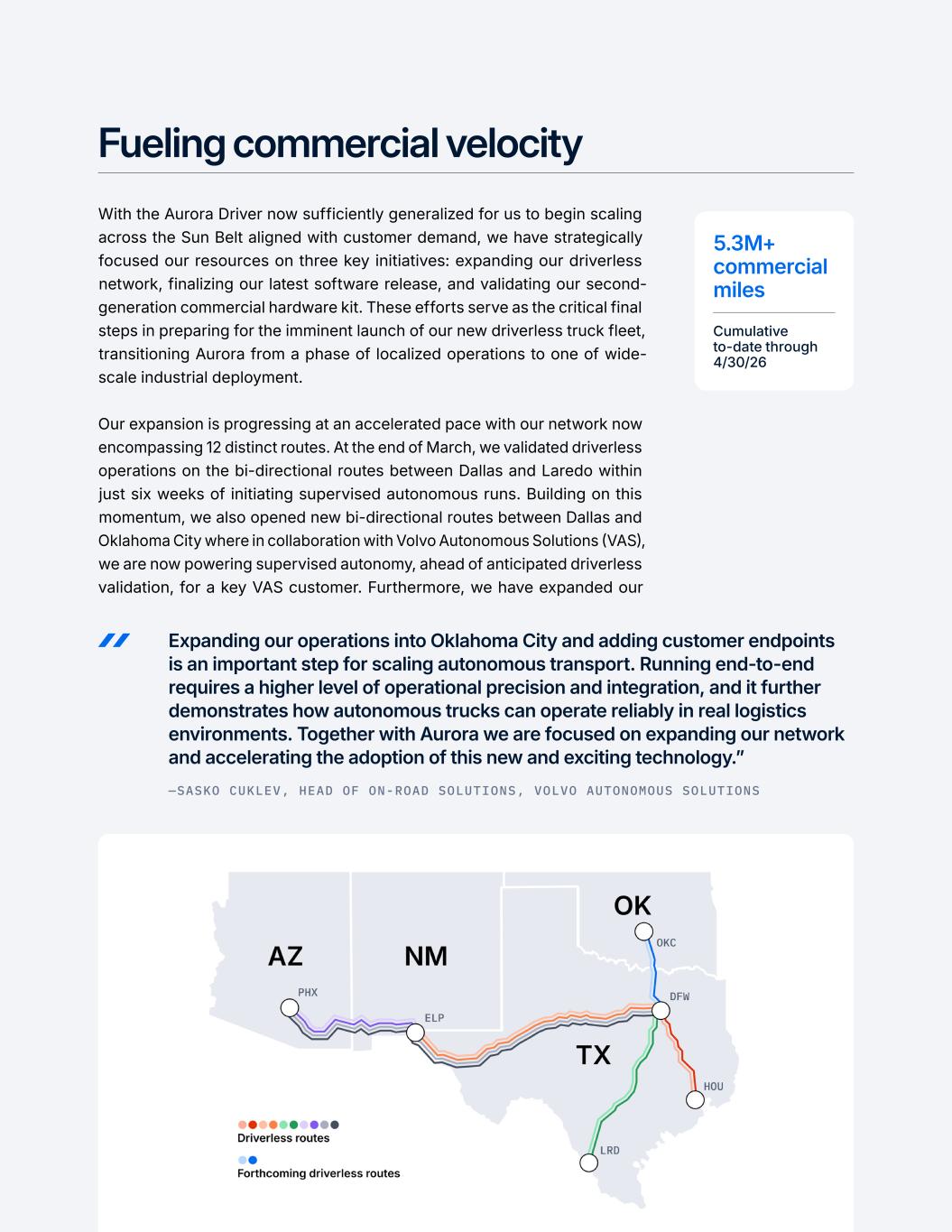
Fueling commercial velocity With the Aurora Driver now sufficiently generalized for us to begin scaling across the Sun Belt aligned with customer demand, we have strategically focused our resources on three key initiatives: expanding our driverless network, finalizing our latest software release, and validating our second- generation commercial hardware kit. These efforts serve as the critical final steps in preparing for the imminent launch of our new driverless truck fleet, transitioning Aurora from a phase of localized operations to one of wide- scale industrial deployment. Our expansion is progressing at an accelerated pace with our network now encompassing 12 distinct routes. At the end of March, we validated driverless operations on the bi-directional routes between Dallas and Laredo within just six weeks of initiating supervised autonomous runs. Building on this momentum, we also opened new bi-directional routes between Dallas and Oklahoma City where in collaboration with Volvo Autonomous Solutions (VAS), we are now powering supervised autonomy, ahead of anticipated driverless validation, for a key VAS customer. Furthermore, we have expanded our 5.3M+ commercial miles Cumulative to-date through 4/30/26 Expanding our operations into Oklahoma City and adding customer endpoints is an important step for scaling autonomous transport. Running end-to-end requires a higher level of operational precision and integration, and it further demonstrates how autonomous trucks can operate reliably in real logistics environments. Together with Aurora we are focused on expanding our network and accelerating the adoption of this new and exciting technology.” —SASKO CUKLEV, HEAD OF ON-ROAD SOLUTIONS, VOLVO AUTONOMOUS SOLUTIONS
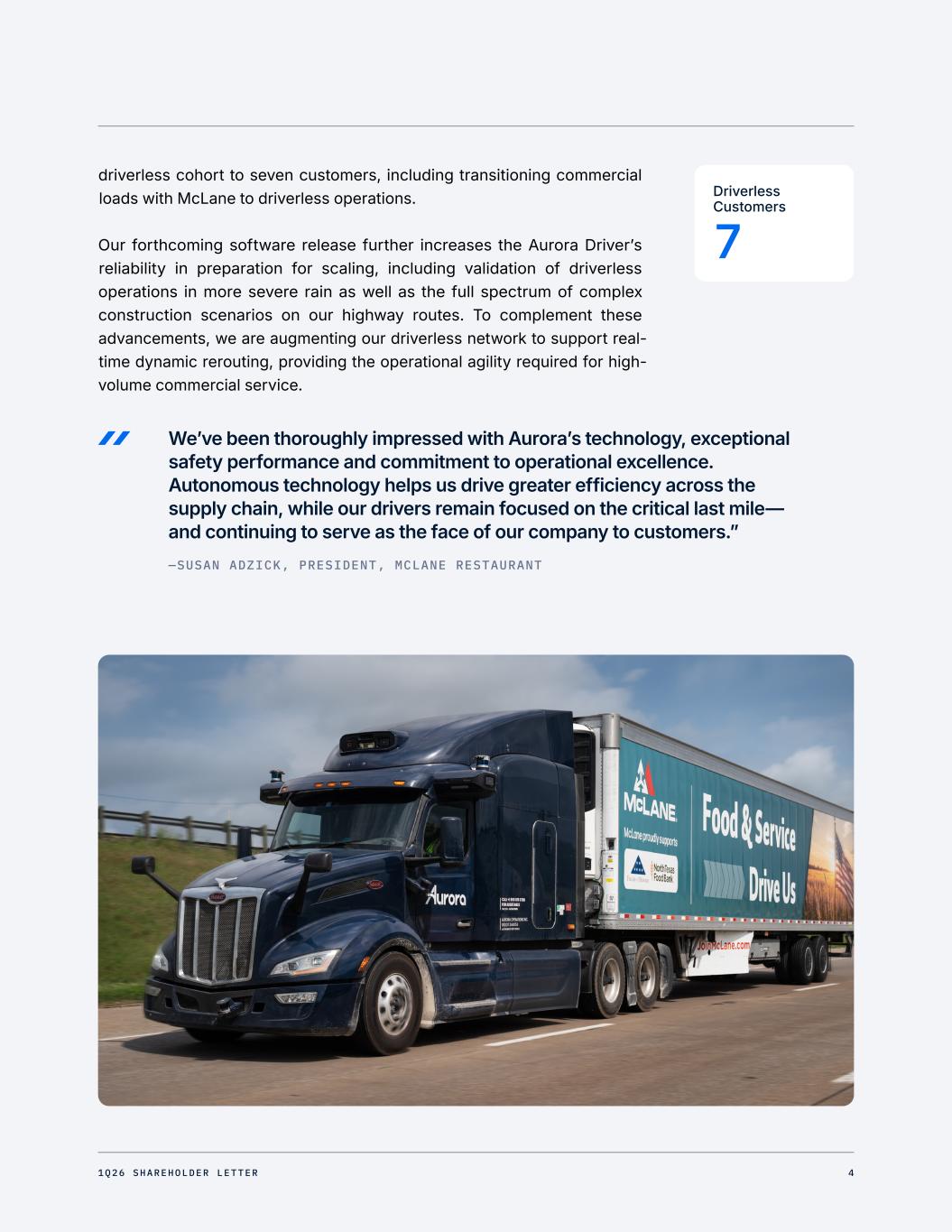
driverless cohort to seven customers, including transitioning commercial loads with McLane to driverless operations. Our forthcoming software release further increases the Aurora Driver’s reliability in preparation for scaling, including validation of driverless operations in more severe rain as well as the full spectrum of complex construction scenarios on our highway routes. To complement these advancements, we are augmenting our driverless network to support real- time dynamic rerouting, providing the operational agility required for high- volume commercial service. Driverless Customers 7 We’ve been thoroughly impressed with Aurora’s technology, exceptional safety performance and commitment to operational excellence. Autonomous technology helps us drive greater efficiency across the supply chain, while our drivers remain focused on the critical last mile— and continuing to serve as the face of our company to customers.” —SUSAN ADZICK, PRESIDENT, MCLANE RESTAURANT 41Q26 SHAREHOLDER LETTER
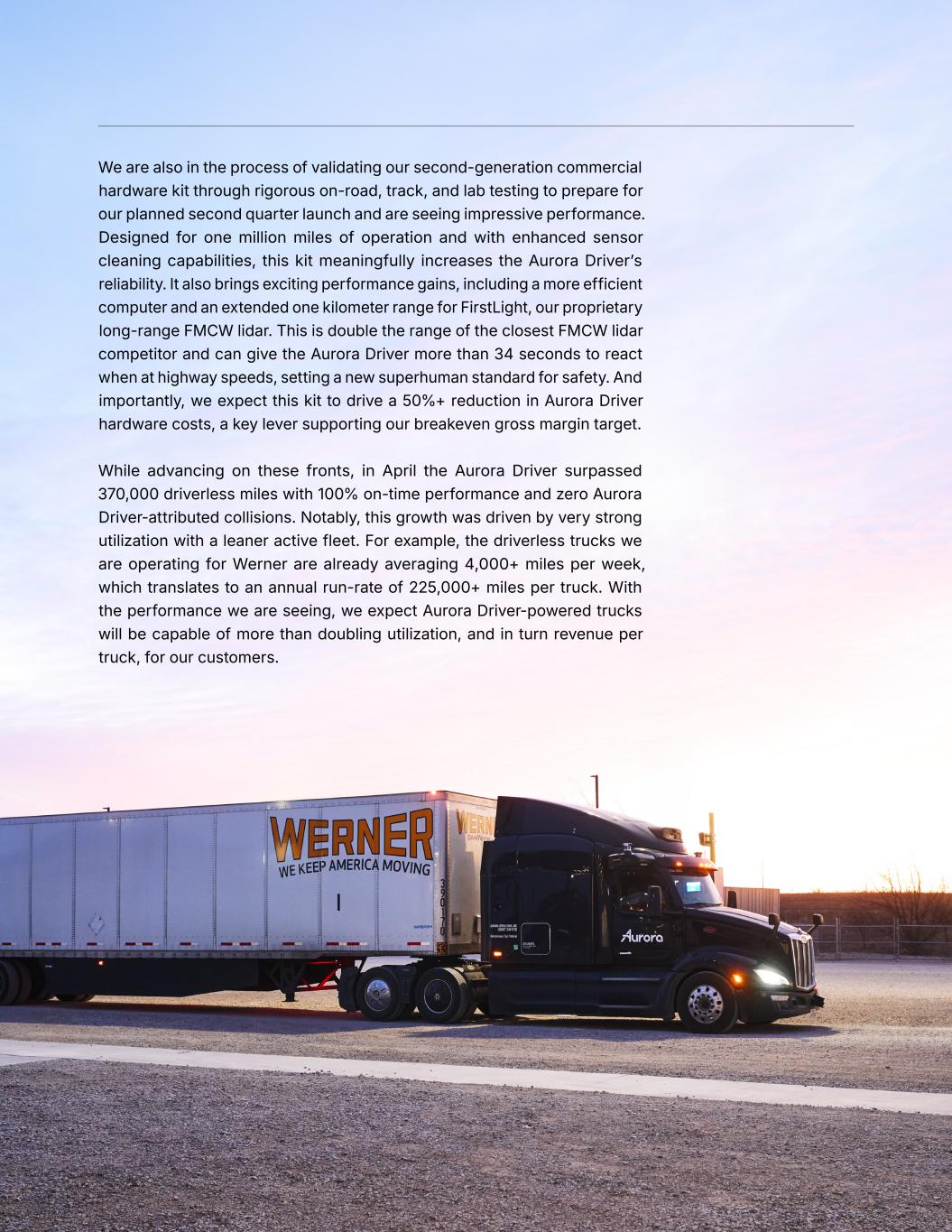
We are also in the process of validating our second-generation commercial hardware kit through rigorous on-road, track, and lab testing to prepare for our planned second quarter launch and are seeing impressive performance. Designed for one million miles of operation and with enhanced sensor cleaning capabilities, this kit meaningfully increases the Aurora Driver’s reliability. It also brings exciting performance gains, including a more efficient computer and an extended one kilometer range for FirstLight, our proprietary long-range FMCW lidar. This is double the range of the closest FMCW lidar competitor and can give the Aurora Driver more than 34 seconds to react when at highway speeds, setting a new superhuman standard for safety. And importantly, we expect this kit to drive a 50%+ reduction in Aurora Driver hardware costs, a key lever supporting our breakeven gross margin target. While advancing on these fronts, in April the Aurora Driver surpassed 370,000 driverless miles with 100% on-time performance and zero Aurora Driver-attributed collisions. Notably, this growth was driven by very strong utilization with a leaner active fleet. For example, the driverless trucks we are operating for Werner are already averaging 4,000+ miles per week, which translates to an annual run-rate of 225,000+ miles per truck. With the performance we are seeing, we expect Aurora Driver-powered trucks will be capable of more than doubling utilization, and in turn revenue per truck, for our customers.
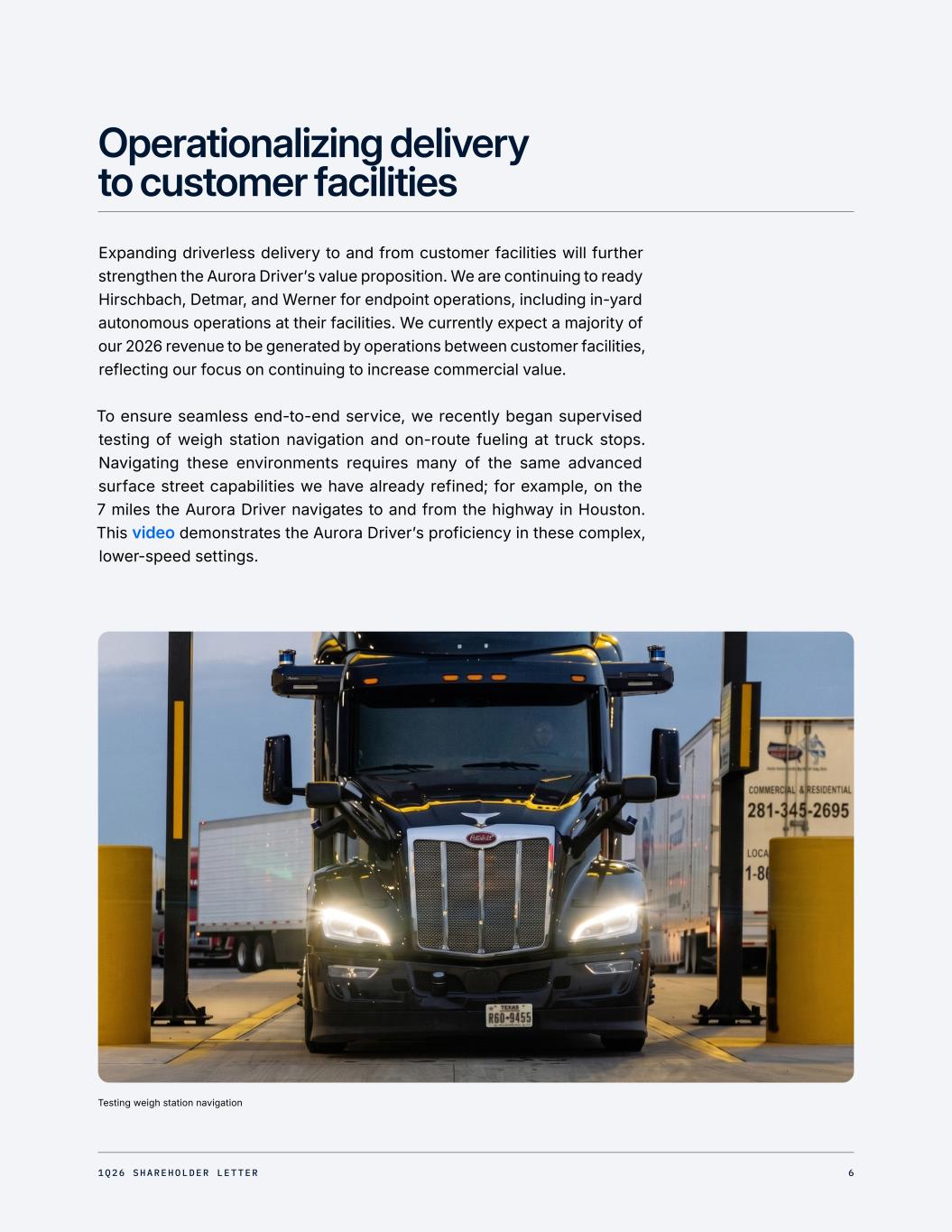
Operationalizing delivery to customer facilities Expanding driverless delivery to and from customer facilities will further strengthen the Aurora Driver’s value proposition. We are continuing to ready Hirschbach, Detmar, and Werner for endpoint operations, including in-yard autonomous operations at their facilities. We currently expect a majority of our 2026 revenue to be generated by operations between customer facilities, reflecting our focus on continuing to increase commercial value. To ensure seamless end-to-end service, we recently began supervised testing of weigh station navigation and on-route fueling at truck stops. Navigating these environments requires many of the same advanced surface street capabilities we have already refined; for example, on the 7 miles the Aurora Driver navigates to and from the highway in Houston. This video demonstrates the Aurora Driver’s proficiency in these complex, lower-speed settings. Testing weigh station navigation 61Q26 SHAREHOLDER LETTER
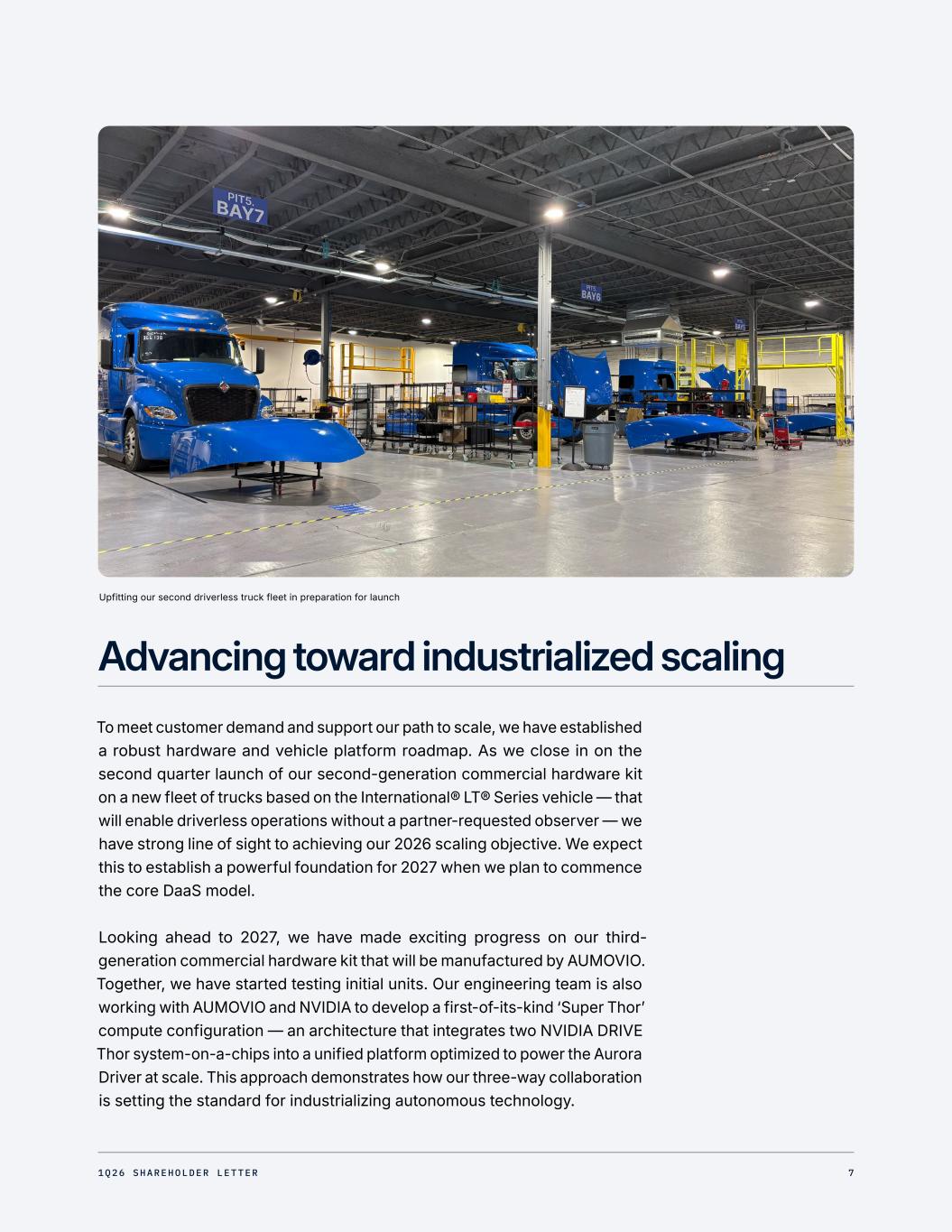
Advancing toward industrialized scaling To meet customer demand and support our path to scale, we have established a robust hardware and vehicle platform roadmap. As we close in on the second quarter launch of our second-generation commercial hardware kit on a new fleet of trucks based on the International® LT® Series vehicle — that will enable driverless operations without a partner-requested observer — we have strong line of sight to achieving our 2026 scaling objective. We expect this to establish a powerful foundation for 2027 when we plan to commence the core DaaS model. Looking ahead to 2027, we have made exciting progress on our third- generation commercial hardware kit that will be manufactured by AUMOVIO. Together, we have started testing initial units. Our engineering team is also working with AUMOVIO and NVIDIA to develop a first-of-its-kind ‘Super Thor’ compute configuration — an architecture that integrates two NVIDIA DRIVE Thor system-on-a-chips into a unified platform optimized to power the Aurora Driver at scale. This approach demonstrates how our three-way collaboration is setting the standard for industrializing autonomous technology. Upfitting our second driverless truck fleet in preparation for launch 71Q26 SHAREHOLDER LETTER
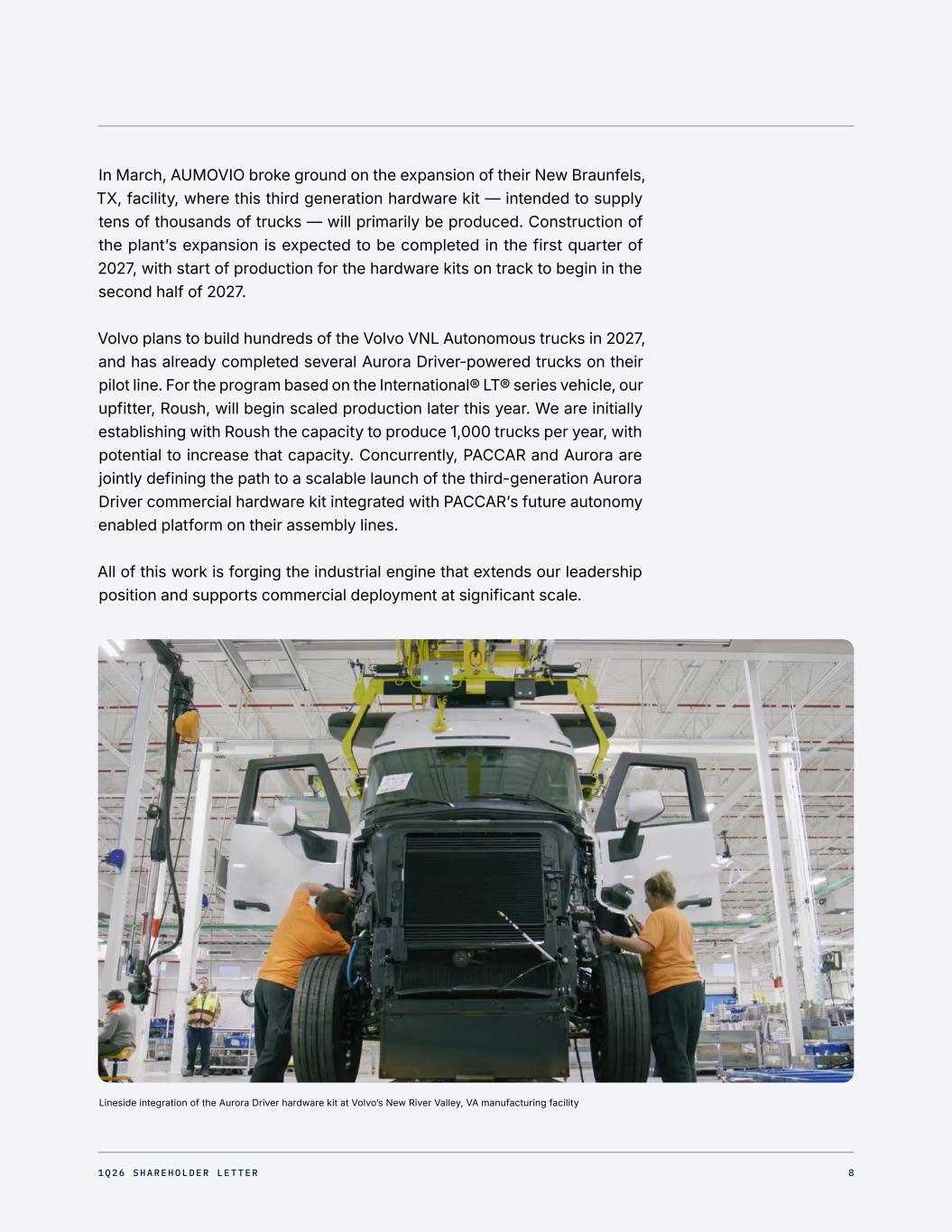
In March, AUMOVIO broke ground on the expansion of their New Braunfels, TX, facility, where this third generation hardware kit — intended to supply tens of thousands of trucks — will primarily be produced. Construction of the plant’s expansion is expected to be completed in the first quarter of 2027, with start of production for the hardware kits on track to begin in the second half of 2027. Volvo plans to build hundreds of the Volvo VNL Autonomous trucks in 2027, and has already completed several Aurora Driver-powered trucks on their pilot line. For the program based on the International® LT® series vehicle, our upfitter, Roush, will begin scaled production later this year. We are initially establishing with Roush the capacity to produce 1,000 trucks per year, with potential to increase that capacity. Concurrently, PACCAR and Aurora are jointly defining the path to a scalable launch of the third-generation Aurora Driver commercial hardware kit integrated with PACCAR’s future autonomy enabled platform on their assembly lines. All of this work is forging the industrial engine that extends our leadership position and supports commercial deployment at significant scale. Lineside integration of the Aurora Driver hardware kit at Volvo’s New River Valley, VA manufacturing facility 81Q26 SHAREHOLDER LETTER
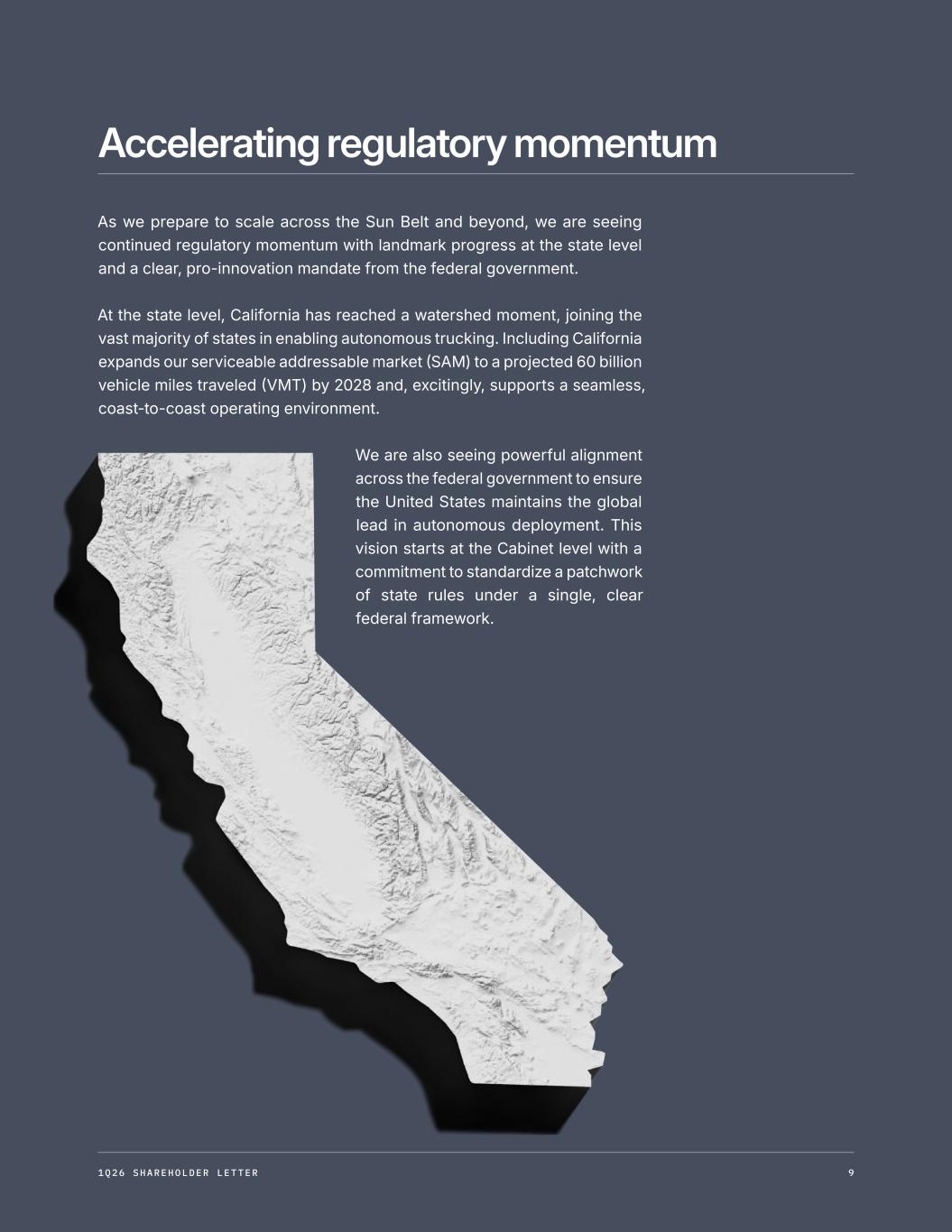
Accelerating regulatory momentum As we prepare to scale across the Sun Belt and beyond, we are seeing continued regulatory momentum with landmark progress at the state level and a clear, pro-innovation mandate from the federal government. At the state level, California has reached a watershed moment, joining the vast majority of states in enabling autonomous trucking. Including California expands our serviceable addressable market (SAM) to a projected 60 billion vehicle miles traveled (VMT) by 2028 and, excitingly, supports a seamless, coast-to-coast operating environment. We are also seeing powerful alignment across the federal government to ensure the United States maintains the global lead in autonomous deployment. This vision starts at the Cabinet level with a commitment to standardize a patchwork of state rules under a single, clear federal framework. 91Q26 SHAREHOLDER LETTER
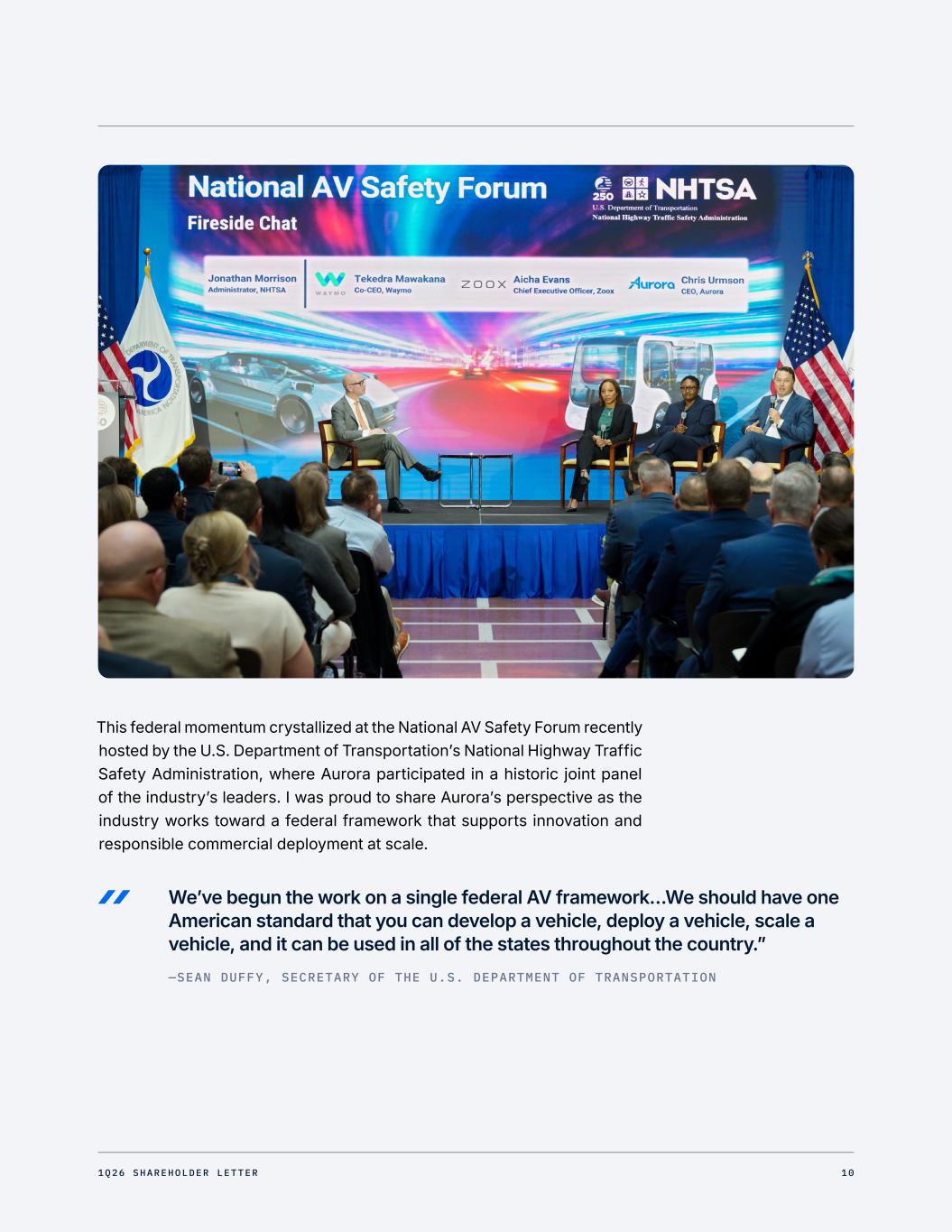
We’ve begun the work on a single federal AV framework…We should have one American standard that you can develop a vehicle, deploy a vehicle, scale a vehicle, and it can be used in all of the states throughout the country.” —SEAN DUFFY, SECRETARY OF THE U.S. DEPARTMENT OF TRANSPORTATION This federal momentum crystallized at the National AV Safety Forum recently hosted by the U.S. Department of Transportation’s National Highway Traffic Safety Administration, where Aurora participated in a historic joint panel of the industry’s leaders. I was proud to share Aurora’s perspective as the industry works toward a federal framework that supports innovation and responsible commercial deployment at scale. 101Q26 SHAREHOLDER LETTER
Setting the pace for autonomous freight At Aurora, we are building a safer, stronger, and more resilient freight ecosystem with both our technology and the people who power it. To back this vision, we recently announced Aurora Works, our commitment to invest in workforce development by establishing educational partnerships and technical training for emerging roles in autonomous trucking. We are at the center of a new era of logistics that improves road safety, fuels economic growth, and creates new, high-skilled American jobs. Autonomous freight represents a step-change for what is possible in global logistics. The Aurora Driver moves the industry beyond traditional constraints toward a world of continuous, high-utilization delivery. With a clear roadmap, deep partnerships, and an accelerating industrial engine, we are well positioned to lead this evolution. The future of freight is on the road, and Aurora is setting the pace. Chris Urmson Co-founder & CEO 111Q26 SHAREHOLDER LETTER
From the desk of our CFO First quarter 2026 revenue totaled $1 million across driverless and vehicle operator supervised commercial loads for Hirschbach, Uber Freight, Werner, FedEx, Schneider, Detmar, and Volvo Autonomous Solutions, among others. The Aurora Driver achieved another record number of commercial miles driven during the quarter, which drove a 10% sequential increase in revenue from the fourth quarter of 2025. First quarter operating loss, including stock-based compensation (SBC), totaled $244 million. Excluding SBC of $46 million, R&D totaled $159 million, SG&A was $34 million, and cost of revenue was $6 million. We used approximately $159 million in operating cash during the first quarter of 2026 and capital expenditures totaled $25 million. As planned, this cash spend was below our externally-communicated quarterly average target. We ended the quarter with a very strong balance sheet, including liquidity of nearly $1.3 billion in cash & short-term and long-term investments. During the first quarter, we generated net proceeds of $14 million from the issuance of Class A common stock through our at-the-market program, which we used to fund the tax liability associated with the vesting of employee restricted stock units during the quarter. We continue to expect 2026 revenue of $14 - $16 million — up 400% year- over-year at the midpoint. Revenue will be back-end loaded — with the fourth quarter projected to contribute over half of full year revenue — as we scale driverless operations (without a partner-requested observer) following the launch of our new fleet. We anticipate exiting the year with more than 200 driverless trucks in operation, which translates to an approximately $80 million revenue run-rate for our TaaS business. This establishes a powerful foundation for 2027 when we expect the core DaaS model to commence. To support our scaling plan, we continue to expect quarterly cash use of approximately $190 - $220 million, on average, in 2026. This includes approximately $150 million in anticipated full year capital expenditures, primarily attributable to our capacity plan. We continue to expect 2026 to represent peak capital spend with capital expenditures expected to decline significantly in 2027 as we transition to our DaaS model and Hardware as a Service structure with AUMOVIO. 121Q26 SHAREHOLDER LETTER
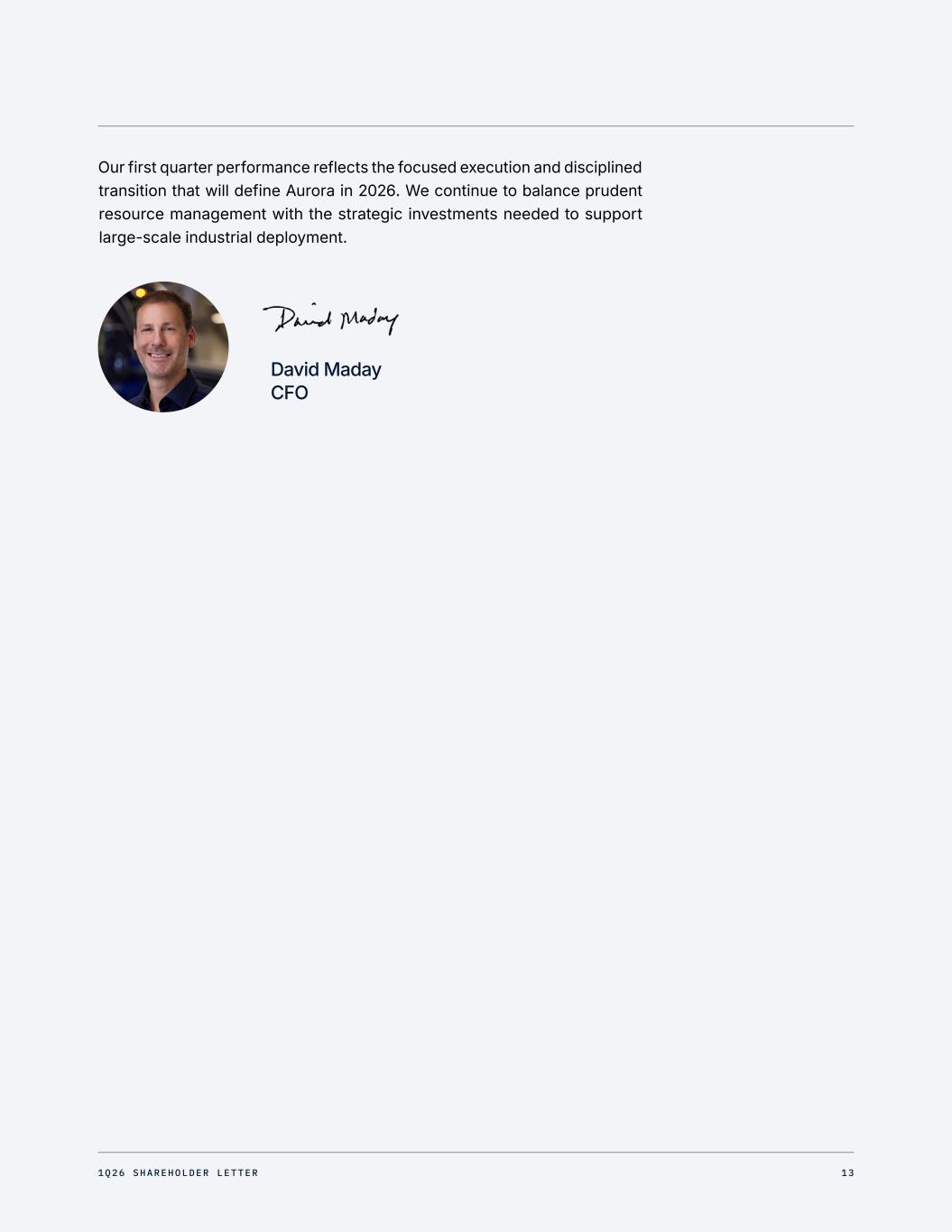
David Maday CFO Our first quarter performance reflects the focused execution and disciplined transition that will define Aurora in 2026. We continue to balance prudent resource management with the strategic investments needed to support large-scale industrial deployment. 131Q26 SHAREHOLDER LETTER
Cautionary statement regarding forward-looking statements This investor letter contains certain forward-looking statements within the meaning of the federal securities laws. The words “believe,” “may,” “will,” “estimate,” “continue,” “anticipate,” “intend,” “expect,” “could,” “would,” “project,” “plan,” “potential,” “target,” and similar expressions and variations thereof are intended to identify forward-looking statements, but are not the exclusive means of identifying such statements. All statements contained in this investor letter that do not relate to matters of historical fact should be considered forward- looking statements, including but not limited to, those statements around our driverless operations and future operating performance; our ability to meet customer demand, reduce costs and general expectations in future periods; the benefits of integrating AI into our product; the safety, efficiency and cost benefits of our technology and product; our ability to achieve certain milestones around, and realize the potential benefits of, the development, manufacturing, scaling (including, but not limited to, the route expansion strategy, the transition to our DaaS model, fleet size and our product’s availability and capabilities) and commercialization of the Aurora Driver and related services, on the timeframe we expect or at all; our relationships with our partners and customers and anticipated benefits that they may derive from our product (including, but not limited to, hardware availability, efficiency gains and increasing revenues and margins); the expected timeline to finalize Hirschbach’s intent to purchase Aurora Driver-powered trucks in a definitive agreement; the timing for developing and launching, and the anticipated benefits of, future generations of hardware kits; the anticipated impact of our product on the freight industry and economy; our expected market share and competitive position; the efficiency and effectiveness of our validation process and profitability of our products and services; the ability of our solutions to scale and improve; the regulatory tailwinds and framework in which we operate and our ability to comply with the current and future regulatory framework; and our financial performance, anticipated investment in truck fleet and expected cash use. These statements are based on management’s current beliefs and assumptions and are neither promises nor guarantees, but involve known and unknown risks, uncertainties and other important factors that may cause our actual results, performance or achievements to be materially different from any future results, performance or achievements expressed or implied by the forward-looking statements. Our projected quarterly cash use is based upon assumptions, including research and development and general and administrative activities, as well as anticipated capital investment, capital expenses and working capital, which are subject to uncertainty and change. Important factors that could cause actual results to differ materially include, among others, risks and uncertainties relating to the development, validation, safety performance, and commercialization of the Aurora Driver; regulatory developments and approvals; the performance of and relationships with partners and customers; market demand and competitive dynamics; and liquidity and access to capital. A discussion of these and other risks and uncertainties is included under the heading “Risk Factors” section of Aurora Innovation, Inc.’s (“Aurora”) Annual Report on Form 10-K for the year ended December 31, 2025, filed with the U.S. Securities and Exchange Commission (the “SEC”) on February 11, 2026, and other documents filed by Aurora from time to time with the SEC, which are accessible on the SEC website at www.sec.gov. Additional information will also be set forth in our Quarterly Report on Form 10-Q for the quarter ended March 31, 2026. All forward-looking statements reflect our beliefs and assumptions only as of the date of this investor letter. Aurora undertakes no obligation to update forward-looking statements to reflect future events or circumstances. 141Q26 SHAREHOLDER LETTER
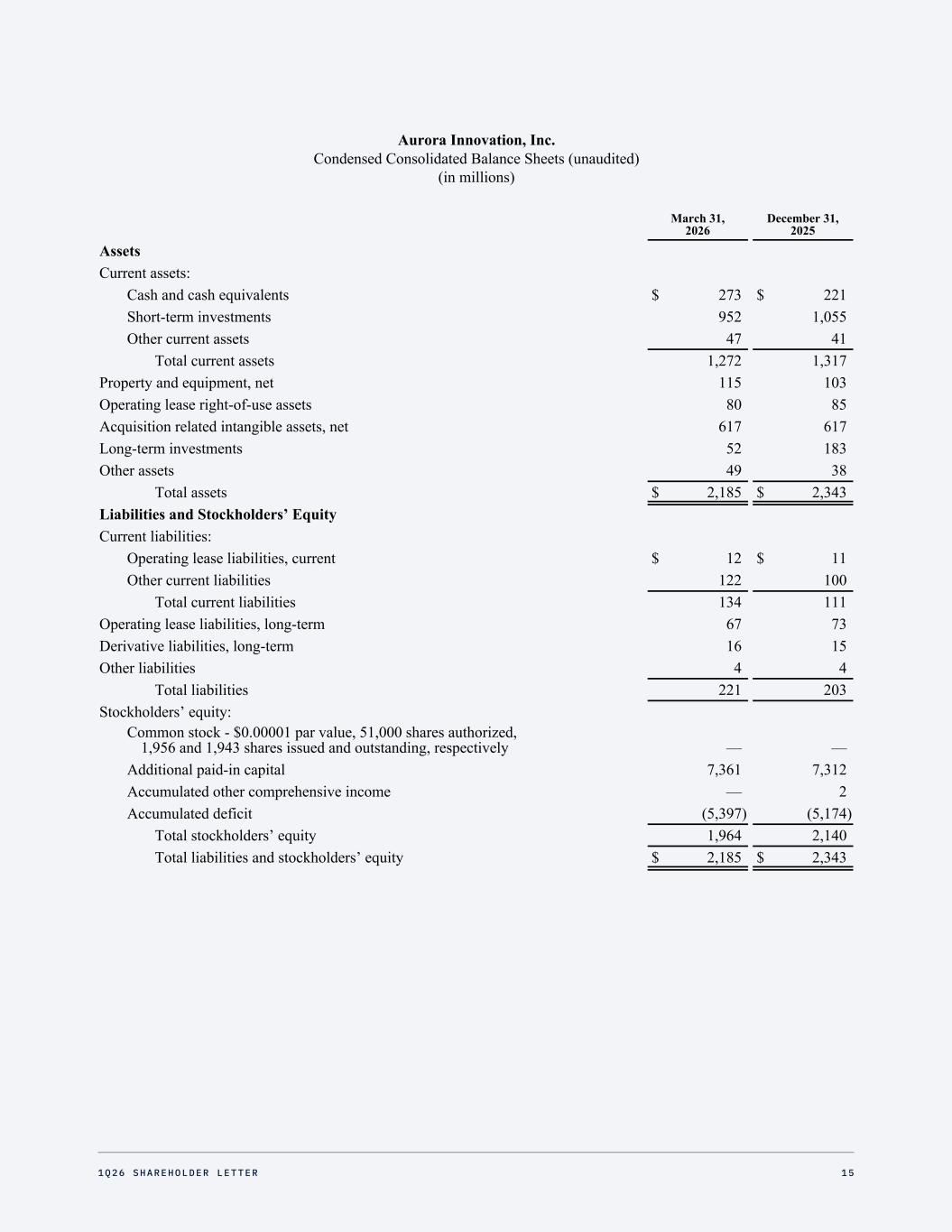
Aurora Innovation, Inc. Condensed Consolidated Balance Sheets (unaudited) (in millions) March 31, 2026 December 31, 2025 Assets Current assets: Cash and cash equivalents $ 273 $ 221 Short-term investments 952 1,055 Other current assets 47 41 Total current assets 1,272 1,317 Property and equipment, net 115 103 Operating lease right-of-use assets 80 85 Acquisition related intangible assets, net 617 617 Long-term investments 52 183 Other assets 49 38 Total assets $ 2,185 $ 2,343 Liabilities and Stockholders’ Equity Current liabilities: Operating lease liabilities, current $ 12 $ 11 Other current liabilities 122 100 Total current liabilities 134 111 Operating lease liabilities, long-term 67 73 Derivative liabilities, long-term 16 15 Other liabilities 4 4 Total liabilities 221 203 Stockholders’ equity: Common stock - $0.00001 par value, 51,000 shares authorized, 1,956 and 1,943 shares issued and outstanding, respectively — — Additional paid-in capital 7,361 7,312 Accumulated other comprehensive income — 2 Accumulated deficit (5,397) (5,174) Total stockholders’ equity 1,964 2,140 Total liabilities and stockholders’ equity $ 2,185 $ 2,343 151Q26 SHAREHOLDER LETTER
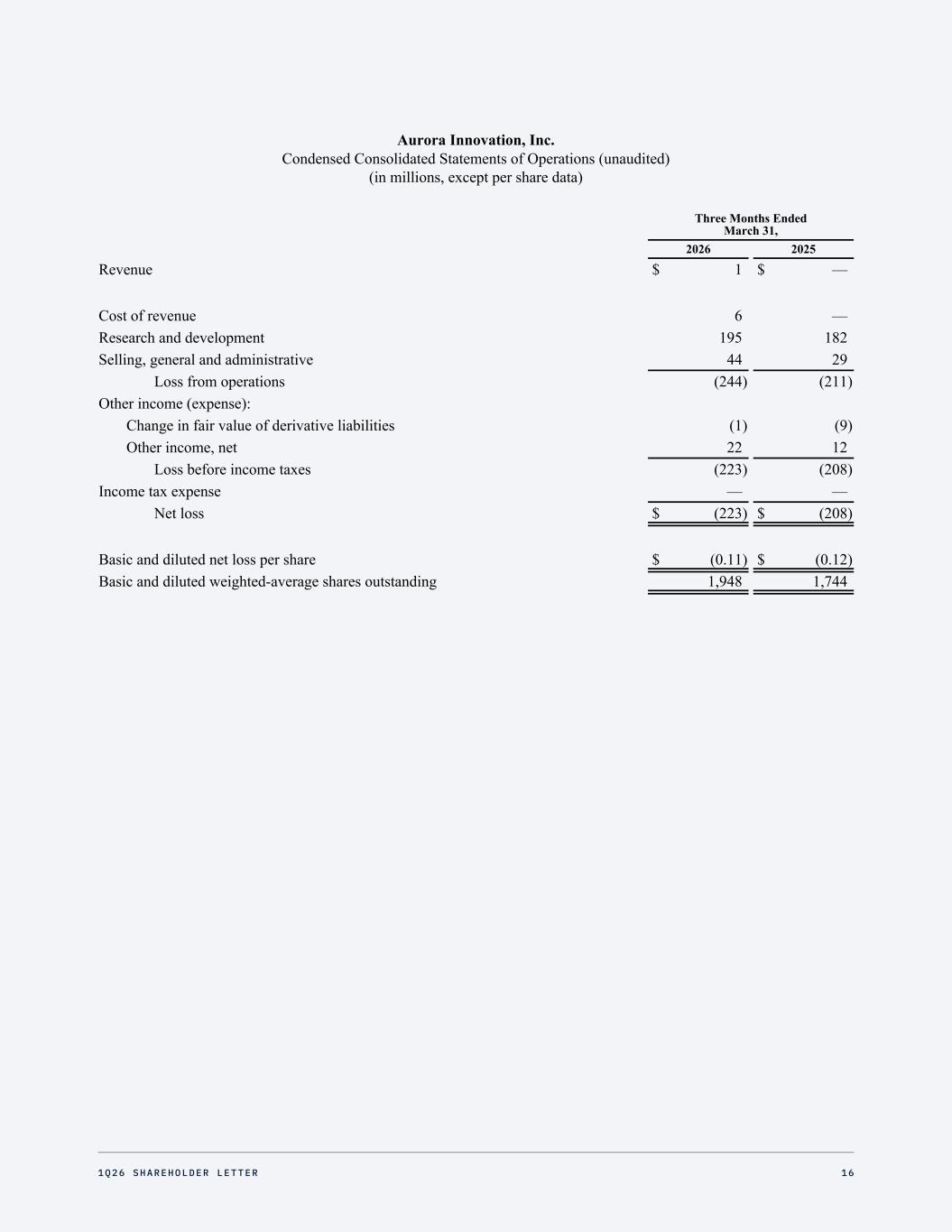
Aurora Innovation, Inc. Condensed Consolidated Statements of Operations (unaudited) (in millions, except per share data) Three Months Ended March 31, 2026 2025 Revenue $ 1 $ — Cost of revenue 6 — Research and development 195 182 Selling, general and administrative 44 29 Loss from operations (244) (211) Other income (expense): Change in fair value of derivative liabilities (1) (9) Other income, net 22 12 Loss before income taxes (223) (208) Income tax expense — — Net loss $ (223) $ (208) Basic and diluted net loss per share $ (0.11) $ (0.12) Basic and diluted weighted-average shares outstanding 1,948 1,744 161Q26 SHAREHOLDER LETTER
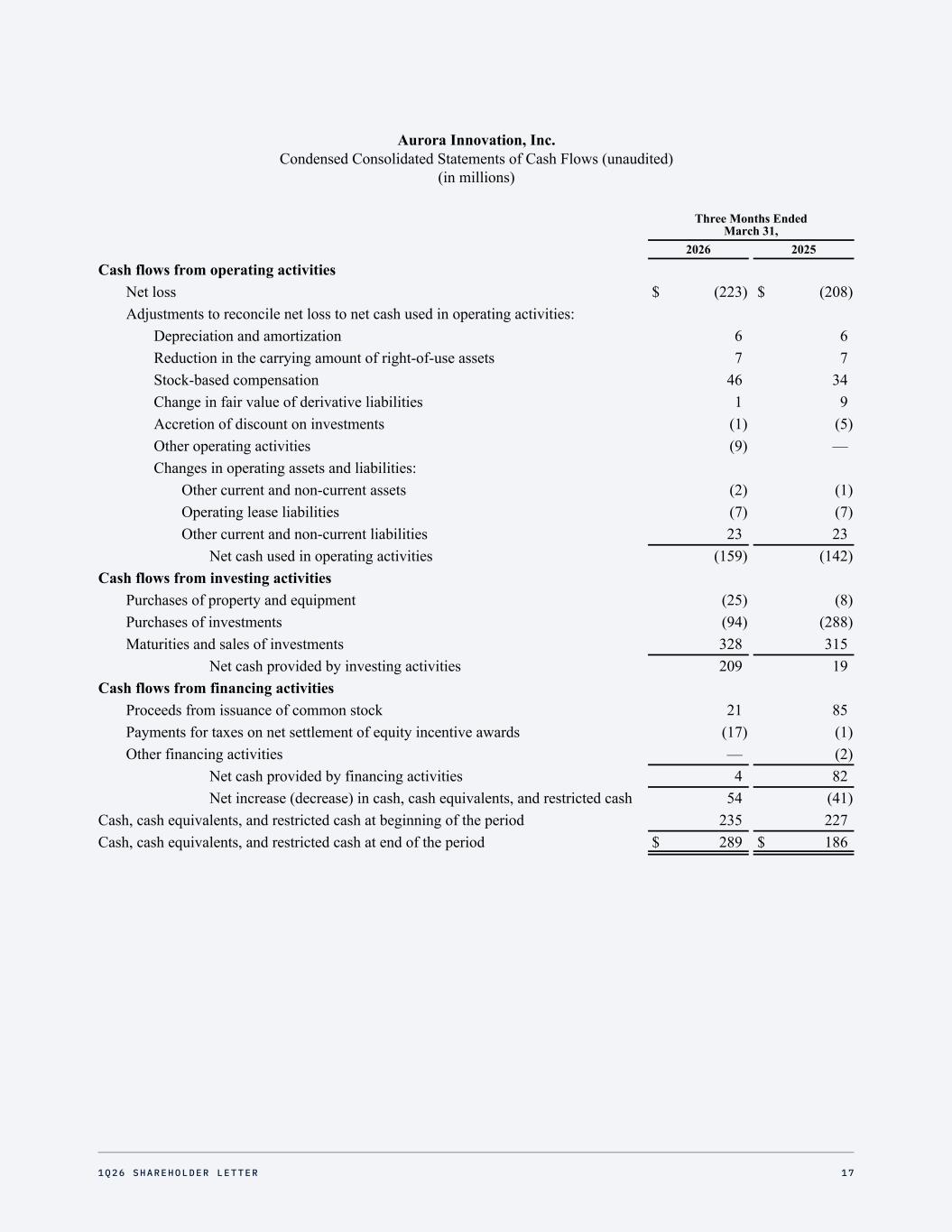
Aurora Innovation, Inc. Condensed Consolidated Statements of Cash Flows (unaudited) (in millions) Three Months Ended March 31, 2026 2025 Cash flows from operating activities Net loss $ (223) $ (208) Adjustments to reconcile net loss to net cash used in operating activities: Depreciation and amortization 6 6 Reduction in the carrying amount of right-of-use assets 7 7 Stock-based compensation 46 34 Change in fair value of derivative liabilities 1 9 Accretion of discount on investments (1) (5) Other operating activities (9) — Changes in operating assets and liabilities: Other current and non-current assets (2) (1) Operating lease liabilities (7) (7) Other current and non-current liabilities 23 23 Net cash used in operating activities (159) (142) Cash flows from investing activities Purchases of property and equipment (25) (8) Purchases of investments (94) (288) Maturities and sales of investments 328 315 Net cash provided by investing activities 209 19 Cash flows from financing activities Proceeds from issuance of common stock 21 85 Payments for taxes on net settlement of equity incentive awards (17) (1) Other financing activities — (2) Net cash provided by financing activities 4 82 Net increase (decrease) in cash, cash equivalents, and restricted cash 54 (41) Cash, cash equivalents, and restricted cash at beginning of the period 235 227 Cash, cash equivalents, and restricted cash at end of the period $ 289 $ 186 171Q26 SHAREHOLDER LETTER
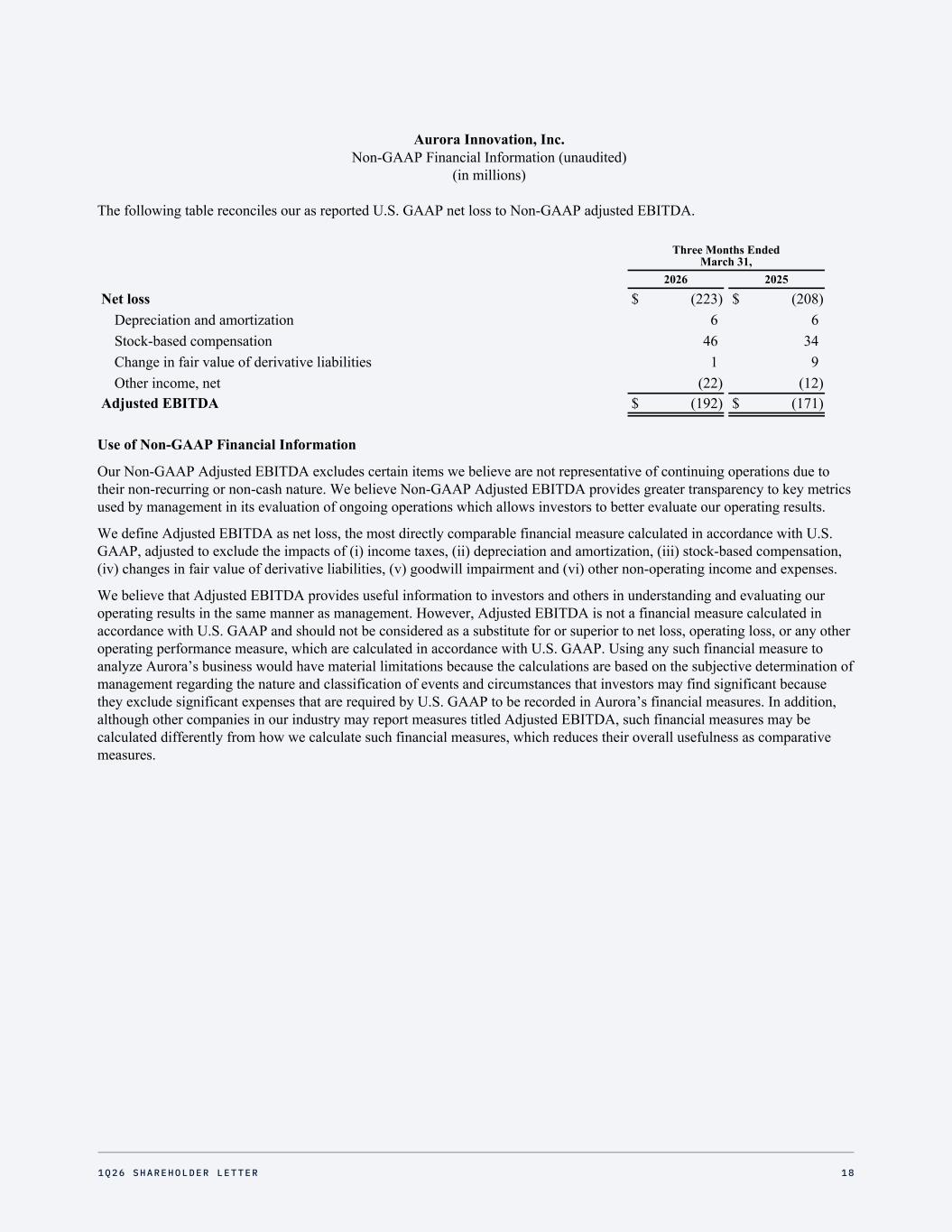
Aurora Innovation, Inc. Non-GAAP Financial Information (unaudited) (in millions) The following table reconciles our as reported U.S. GAAP net loss to Non-GAAP adjusted EBITDA. Three Months Ended March 31, 2026 2025 Net loss $ (223) $ (208) Depreciation and amortization 6 6 Stock-based compensation 46 34 Change in fair value of derivative liabilities 1 9 Other income, net (22) (12) Adjusted EBITDA $ (192) $ (171) Use of Non-GAAP Financial Information Our Non-GAAP Adjusted EBITDA excludes certain items we believe are not representative of continuing operations due to their non-recurring or non-cash nature. We believe Non-GAAP Adjusted EBITDA provides greater transparency to key metrics used by management in its evaluation of ongoing operations which allows investors to better evaluate our operating results. We define Adjusted EBITDA as net loss, the most directly comparable financial measure calculated in accordance with U.S. GAAP, adjusted to exclude the impacts of (i) income taxes, (ii) depreciation and amortization, (iii) stock-based compensation, (iv) changes in fair value of derivative liabilities, (v) goodwill impairment and (vi) other non-operating income and expenses. We believe that Adjusted EBITDA provides useful information to investors and others in understanding and evaluating our operating results in the same manner as management. However, Adjusted EBITDA is not a financial measure calculated in accordance with U.S. GAAP and should not be considered as a substitute for or superior to net loss, operating loss, or any other operating performance measure, which are calculated in accordance with U.S. GAAP. Using any such financial measure to analyze Aurora’s business would have material limitations because the calculations are based on the subjective determination of management regarding the nature and classification of events and circumstances that investors may find significant because they exclude significant expenses that are required by U.S. GAAP to be recorded in Aurora’s financial measures. In addition, although other companies in our industry may report measures titled Adjusted EBITDA, such financial measures may be calculated differently from how we calculate such financial measures, which reduces their overall usefulness as comparative measures. 181Q26 SHAREHOLDER LETTER