EX-99.1
Published on October 28, 2026
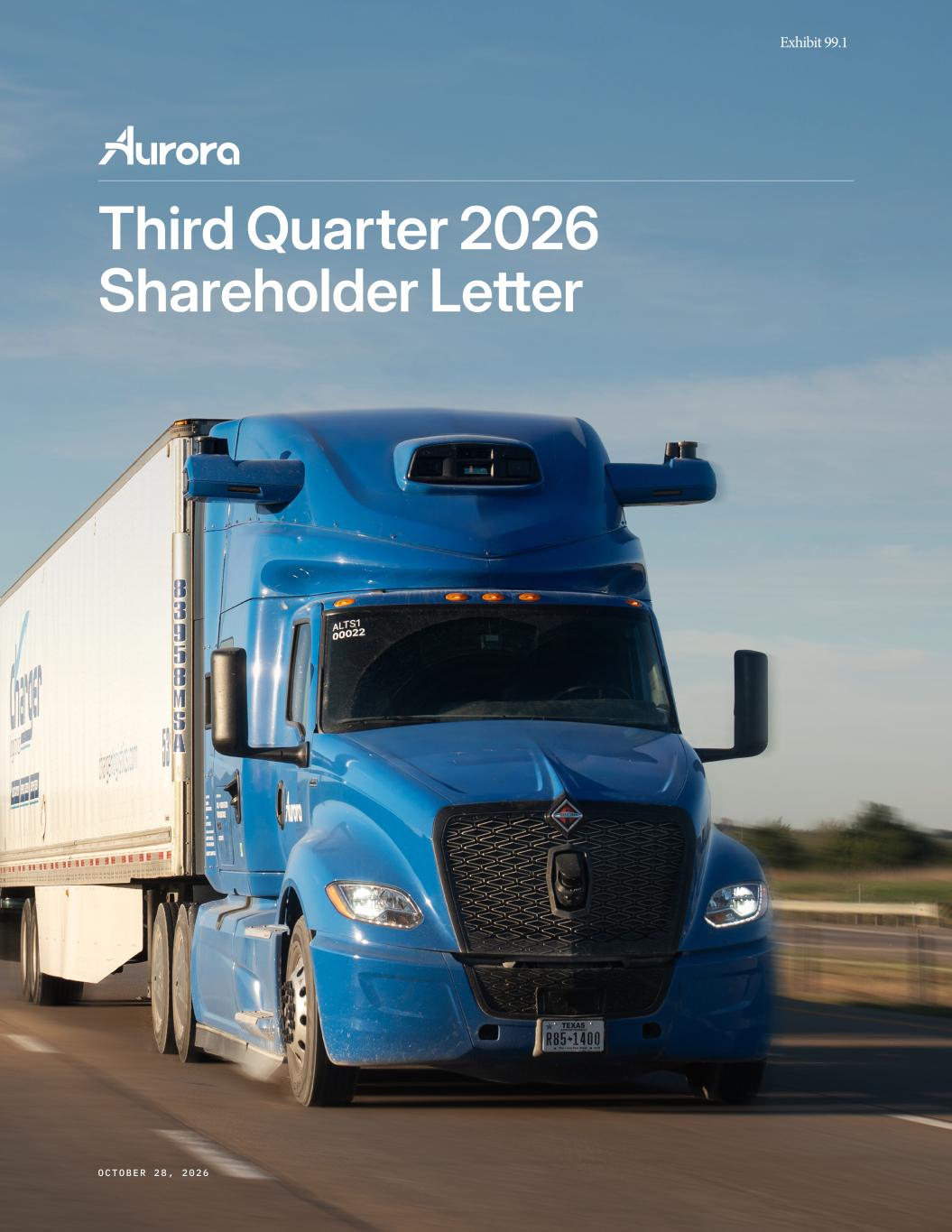
Third Quarter 2026 Shareholder Letter OCTOBER 28, 2026 Exhibit 99.1
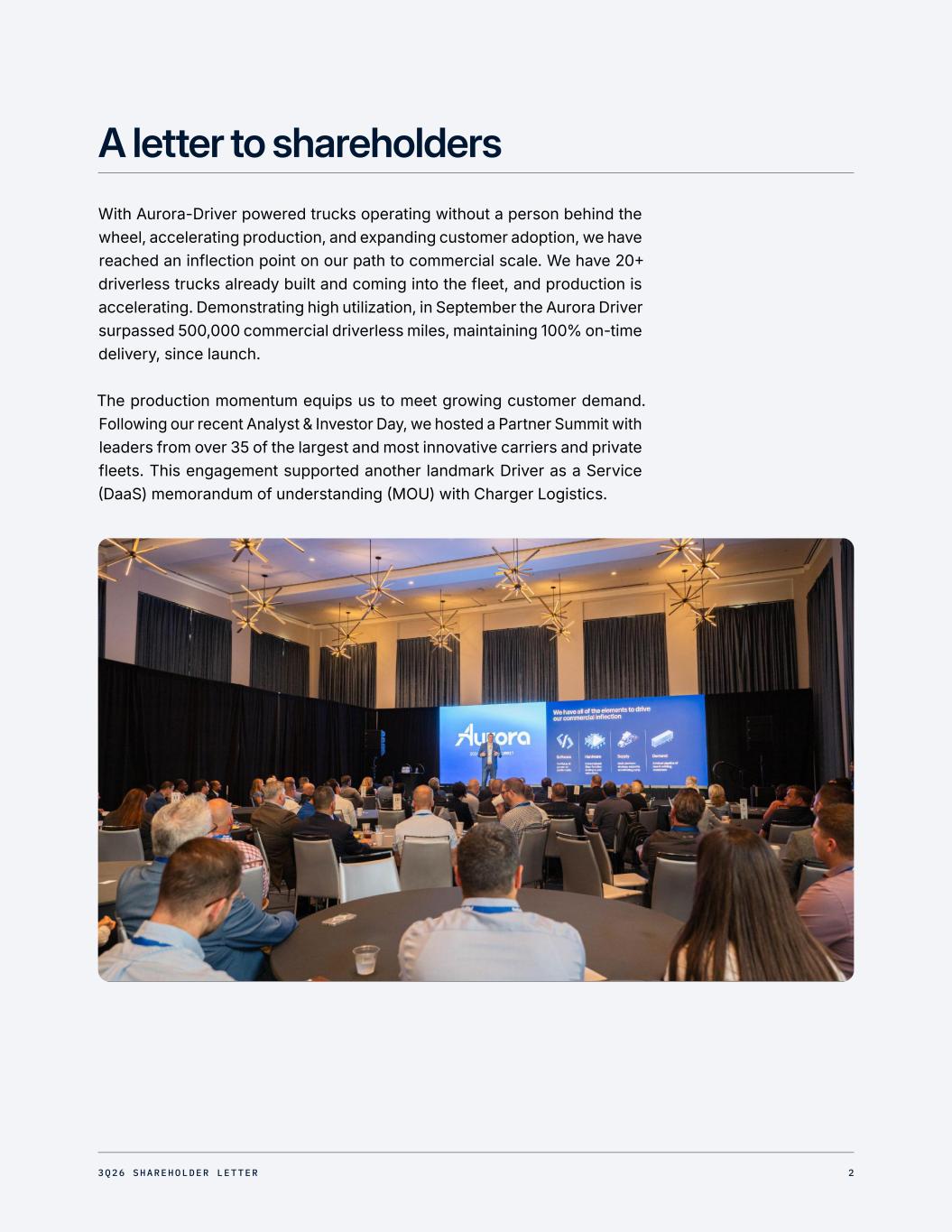
A letter to shareholders With Aurora-Driver powered trucks operating without a person behind the wheel, accelerating production, and expanding customer adoption, we have reached an inflection point on our path to commercial scale. We have 20+ driverless trucks already built and coming into the fleet, and production is accelerating. Demonstrating high utilization, in September the Aurora Driver surpassed 500,000 commercial driverless miles, maintaining 100% on-time delivery, since launch. The production momentum equips us to meet growing customer demand. Following our recent Analyst & Investor Day, we hosted a Partner Summit with leaders from over 35 of the largest and most innovative carriers and private fleets. This engagement supported another landmark Driver as a Service (DaaS) memorandum of understanding (MOU) with Charger Logistics. 23Q26 SHAREHOLDER LETTER
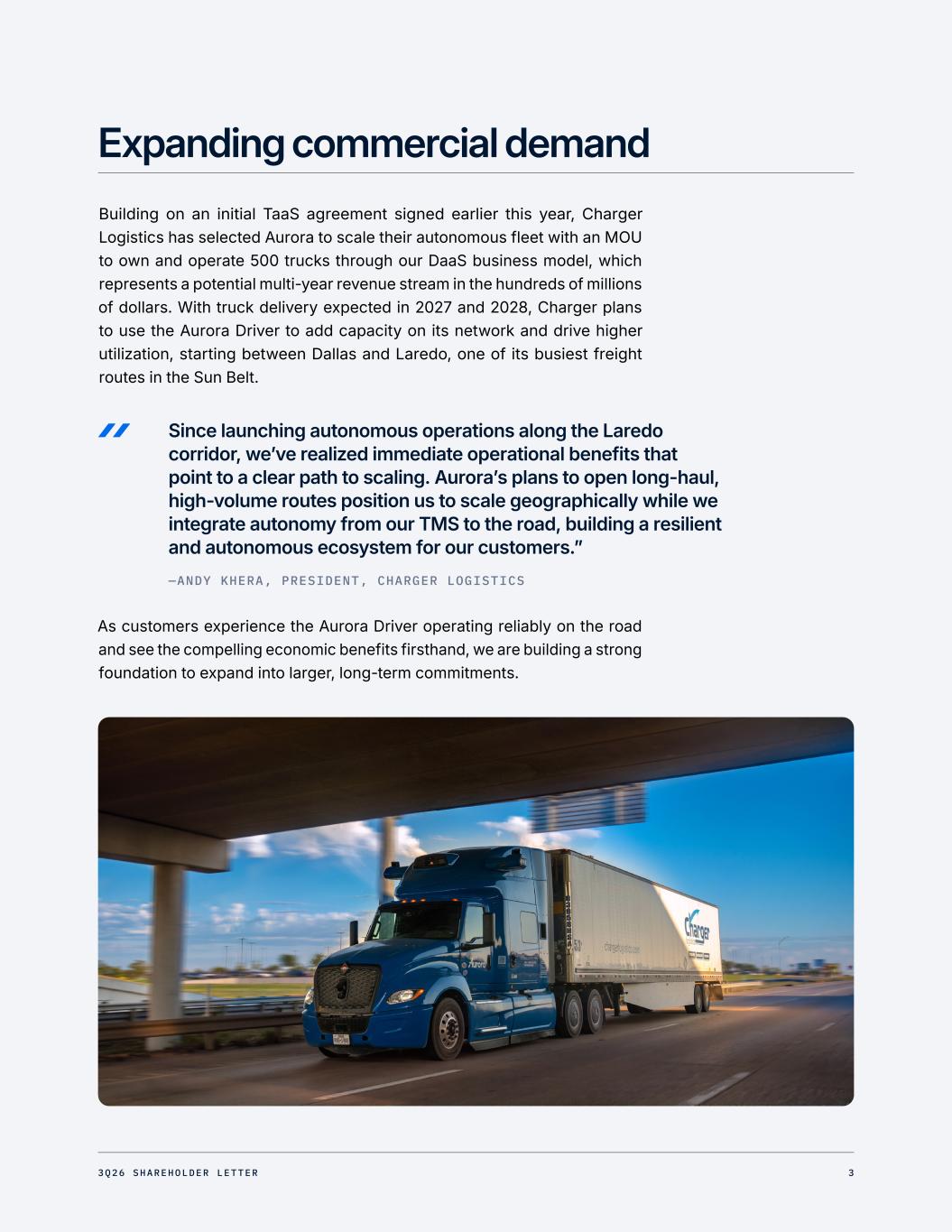
Expanding commercial demand Building on an initial TaaS agreement signed earlier this year, Charger Logistics has selected Aurora to scale their autonomous fleet with an MOU to own and operate 500 trucks through our DaaS business model, which represents a potential multi-year revenue stream in the hundreds of millions of dollars. With truck delivery expected in 2027 and 2028, Charger plans to use the Aurora Driver to add capacity on its network and drive higher utilization, starting between Dallas and Laredo, one of its busiest freight routes in the Sun Belt. As customers experience the Aurora Driver operating reliably on the road and see the compelling economic benefits firsthand, we are building a strong foundation to expand into larger, long-term commitments. Since launching autonomous operations along the Laredo corridor, we’ve realized immediate operational benefits that point to a clear path to scaling. Aurora’s plans to open long-haul, high-volume routes position us to scale geographically while we integrate autonomy from our TMS to the road, building a resilient and autonomous ecosystem for our customers.” —ANDY KHERA, PRESIDENT, CHARGER LOGISTICS 33Q26 SHAREHOLDER LETTER
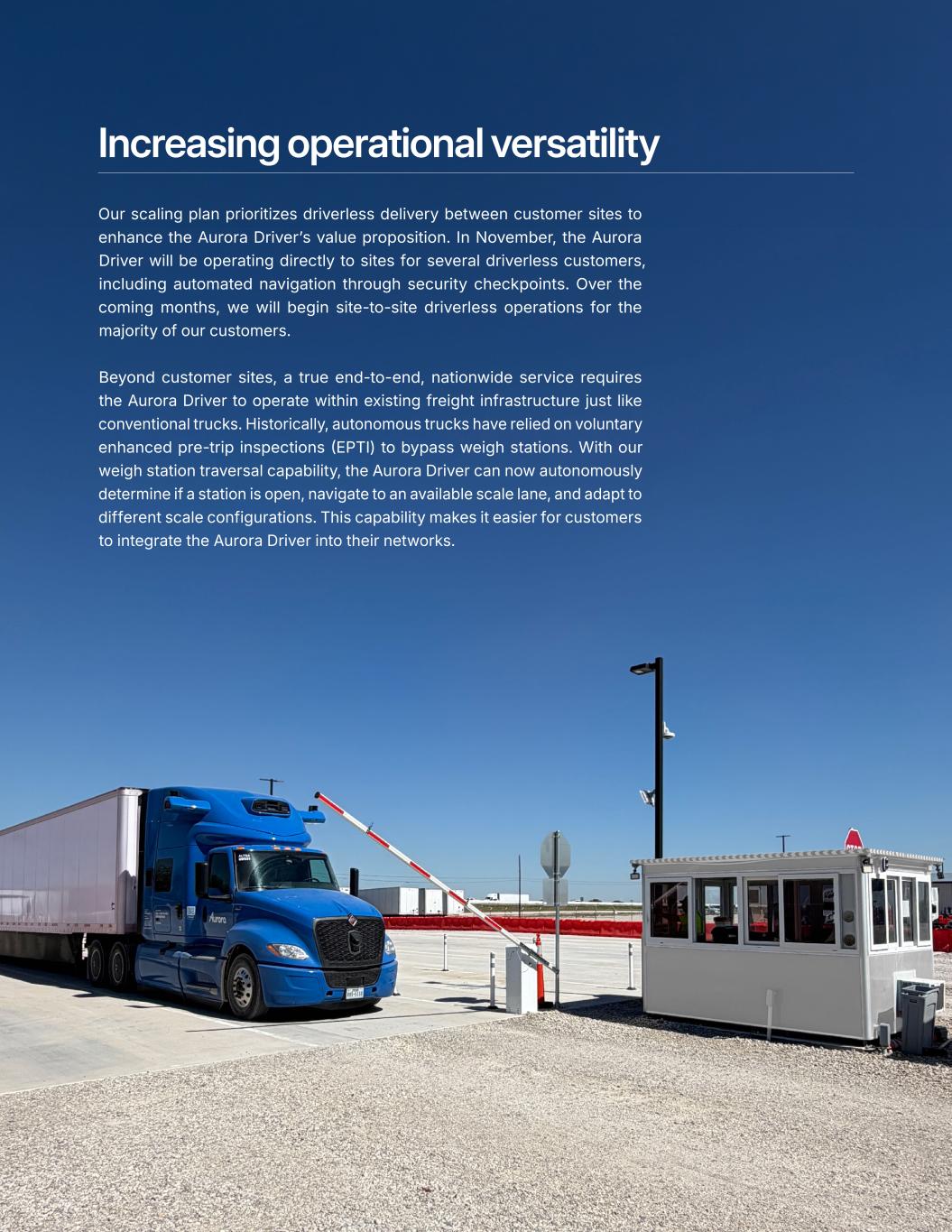
Increasing operational versatility Our scaling plan prioritizes driverless delivery between customer sites to enhance the Aurora Driver’s value proposition. In November, the Aurora Driver will be operating directly to sites for several driverless customers, including automated navigation through security checkpoints. Over the coming months, we will begin site-to-site driverless operations for the majority of our customers. Beyond customer sites, a true end-to-end, nationwide service requires the Aurora Driver to operate within existing freight infrastructure just like conventional trucks. Historically, autonomous trucks have relied on voluntary enhanced pre-trip inspections (EPTI) to bypass weigh stations. With our weigh station traversal capability, the Aurora Driver can now autonomously determine if a station is open, navigate to an available scale lane, and adapt to different scale configurations. This capability makes it easier for customers to integrate the Aurora Driver into their networks.
Advancing regulatory alignment As the Aurora Driver’s capabilities continue to expand, the regulatory landscape increasingly supports scaled deployment. At the federal level, the U.S. Department of Transportation (USDOT) is advancing a unified framework to accelerate commercial deployment while asserting global technological leadership. Under the Automated Vehicles National Strategy (FY 2026–2030), USDOT established a clear roadmap built on the premise that autonomous driving technology offers a generational leap in roadway safety by reducing error factors such as distraction, fatigue, and impairment. The Trump Administration is committed to safely unleashing American innovation on our roads. We’re doing so because of the exciting promise new technologies like AVs have in reducing roadway fatalities, enhancing mobility, and fundamentally reshaping how people move for the better. This strategy outlined a plan to empower our innovators to build faster, smarter and safer than ever before.” —SEAN DUFFY, U.S. TRANSPORTATION SECRETARY The strategy expands upon the National Highway Traffic Safety Administration’s 2025 AV Framework and defines specific action items across four foundational pillars: • Prioritize Safety Provide guardrails to support and improve safety as the AV industry grows. • Provide Regulatory Certainty Modernize existing regulations, remove unnecessary barriers, streamline processes, and provide clarity and predictability. Work towards consistency. • Promote American Innovation Expand commercial availability and operation for passenger and freight applications domestically and promote U.S. interests abroad. • Facilitate Interoperable Corridors Convene national stakeholders to promote seamless cross-State interoperability within the transportation system. 53Q26 SHAREHOLDER LETTER
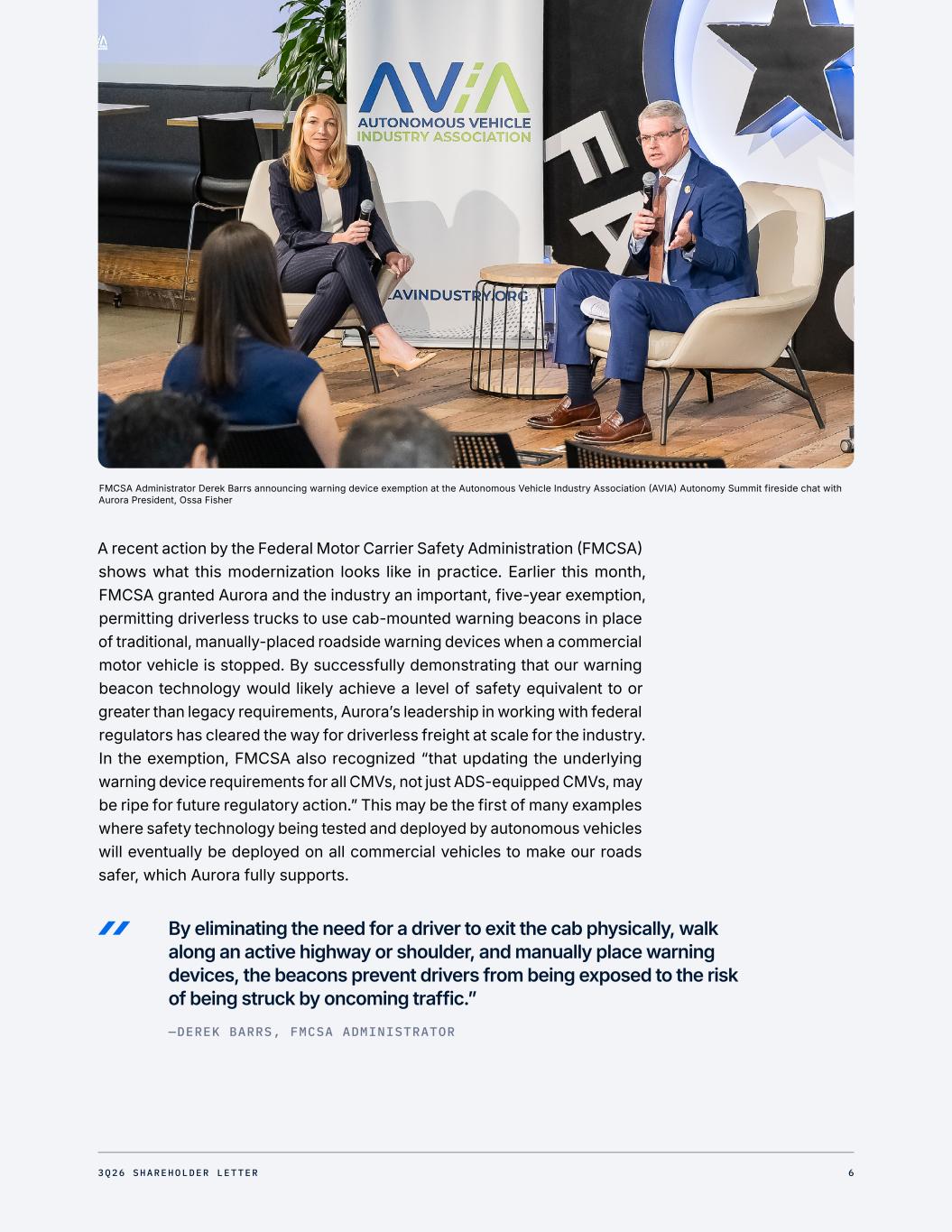
A recent action by the Federal Motor Carrier Safety Administration (FMCSA) shows what this modernization looks like in practice. Earlier this month, FMCSA granted Aurora and the industry an important, five-year exemption, permitting driverless trucks to use cab-mounted warning beacons in place of traditional, manually-placed roadside warning devices when a commercial motor vehicle is stopped. By successfully demonstrating that our warning beacon technology would likely achieve a level of safety equivalent to or greater than legacy requirements, Aurora’s leadership in working with federal regulators has cleared the way for driverless freight at scale for the industry. In the exemption, FMCSA also recognized “that updating the underlying warning device requirements for all CMVs, not just ADS-equipped CMVs, may be ripe for future regulatory action.” This may be the first of many examples where safety technology being tested and deployed by autonomous vehicles will eventually be deployed on all commercial vehicles to make our roads safer, which Aurora fully supports. By eliminating the need for a driver to exit the cab physically, walk along an active highway or shoulder, and manually place warning devices, the beacons prevent drivers from being exposed to the risk of being struck by oncoming traffic.” —DEREK BARRS, FMCSA ADMINISTRATOR FMCSA Administrator Derek Barrs announcing warning device exemption at the Autonomous Vehicle Industry Association (AVIA) Autonomy Summit fireside chat with Aurora President, Ossa Fisher 63Q26 SHAREHOLDER LETTER
While existing state law already provides a clear path for our planned multi- state expansion, USDOT’s regulatory modernization would complement these state pathways by fostering national consistency. This federal alignment would further strengthen long-term operational predictability, enhance broader public trust, and maintain U.S. leadership in autonomous technology. The bipartisan BUILD America 250 Act would replace the state-by- state maze with one clear set of strong, transparent federal safety rules, letting American companies build, test and improve their technology here rather than taking their investment elsewhere.” —GARRET GRAVES, FORMER MEMBER OF CONGRESS In addition, we are seeing a growing number of voices calling for the rapid passage of the BUILD America 250 Act, recognizing the importance of the autonomous trucking provisions that are included in the legislation today. 73Q26 SHAREHOLDER LETTER
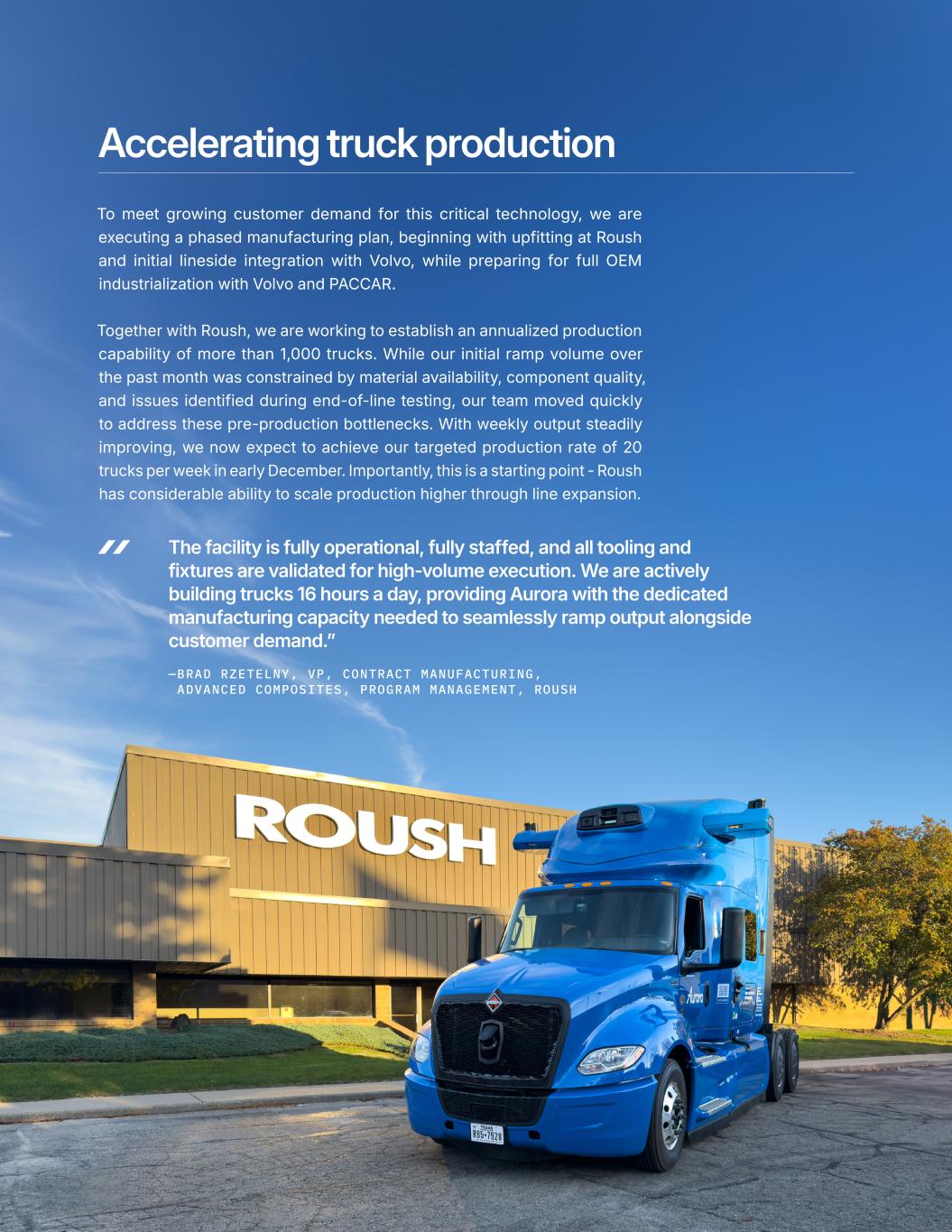
Accelerating truck production To meet growing customer demand for this critical technology, we are executing a phased manufacturing plan, beginning with upfitting at Roush and initial lineside integration with Volvo, while preparing for full OEM industrialization with Volvo and PACCAR. Together with Roush, we are working to establish an annualized production capability of more than 1,000 trucks. While our initial ramp volume over the past month was constrained by material availability, component quality, and issues identified during end-of-line testing, our team moved quickly to address these pre-production bottlenecks. With weekly output steadily improving, we now expect to achieve our targeted production rate of 20 trucks per week in early December. Importantly, this is a starting point - Roush has considerable ability to scale production higher through line expansion. The facility is fully operational, fully staffed, and all tooling and fixtures are validated for high-volume execution. We are actively building trucks 16 hours a day, providing Aurora with the dedicated manufacturing capacity needed to seamlessly ramp output alongside customer demand.” —BRAD RZETELNY, VP, CONTRACT MANUFACTURING, ADVANCED COMPOSITES, PROGRAM MANAGEMENT, ROUSH
Our strategic partnership with Volvo continues to advance, driven by deep operational alignment and growing customer demand. This supports their plans for the deployment of more than 300 driverless trucks in 2027 ahead of full industrial production in 2028. Similarly, our relationship with PACCAR continues to progress, driven by a mutual dedication to safety and rigorous product development. Fleet customers are increasingly focused on operational efficiency and freight reliability to navigate industry challenges. Together, we are working to seamlessly integrate the Aurora Driver onto PACCAR trucks, giving carriers the flexibility they are demanding. This is a deeply co-engineered partnership where our teams have been working side-by-side from design to commercialization. We have built a strong foundation together – merging our purpose built and purpose designed Volvo VNL Autonomous with the Aurora Driver. Now we jointly look forward to introducing fully driverless operations early next year, helping address capacity challenges in the transport industry while giving customers safe, reliable deliveries and consistent performance, day after day.” —NILS JAEGER, PRESIDENT, VOLVO AUTONOMOUS SOLUTIONS The dialogue with fleets has fundamentally shifted from testing technology to capturing efficiency. Carriers facing labor shortages, rising fuel costs, and tight margins want safe, reliable solutions that protect their bottom line and deliver on customer commitments. Partnering with Aurora to integrate the Aurora Driver directly onto our Peterbilt and Kenworth production lines will give our customers the operational efficiency and scalability they require.” —NOELLE PARLIER, GENERAL MANAGER, PACCAR INNOVATION CENTER, PACCAR 93Q26 SHAREHOLDER LETTER
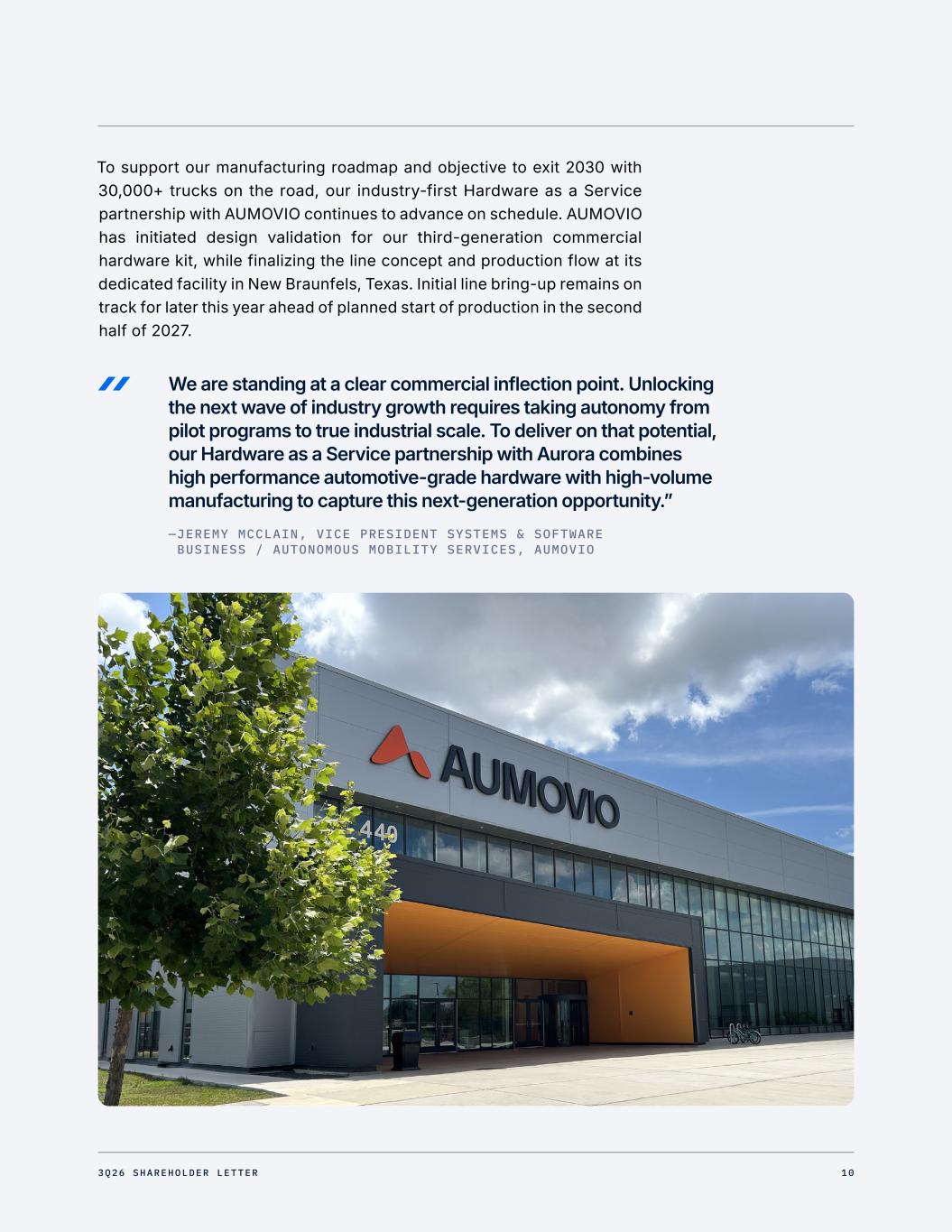
To support our manufacturing roadmap and objective to exit 2030 with 30,000+ trucks on the road, our industry-first Hardware as a Service partnership with AUMOVIO continues to advance on schedule. AUMOVIO has initiated design validation for our third-generation commercial hardware kit, while finalizing the line concept and production flow at its dedicated facility in New Braunfels, Texas. Initial line bring-up remains on track for later this year ahead of planned start of production in the second half of 2027. We are standing at a clear commercial inflection point. Unlocking the next wave of industry growth requires taking autonomy from pilot programs to true industrial scale. To deliver on that potential, our Hardware as a Service partnership with Aurora combines high performance automotive-grade hardware with high-volume manufacturing to capture this next-generation opportunity.” —JEREMY MCCLAIN, VICE PRESIDENT SYSTEMS & SOFTWARE BUSINESS / AUTONOMOUS MOBILITY SERVICES, AUMOVIO 103Q26 SHAREHOLDER LETTER
Creating immense value As we look ahead, the pieces are all now firmly in place. With Verifiable AI proven on public roads, automotive-grade hardware, accelerating manufacturing, and growing commercial demand, Aurora is standing at a true commercial inflection point. As we bring autonomous freight to commercial scale, we are uniquely positioned to make our roads safer, unlock efficiency across the supply chain, and create immense, enduring value for the industry and our shareholders. Chris Urmson Co-founder & CEO 113Q26 SHAREHOLDER LETTER
From the desk of our CFO Third quarter 2026 revenue totaled $3 million across driverless and vehicle operator-supervised commercial loads. The Aurora Driver achieved another record number of commercial miles driven during the quarter. Third quarter operating loss, including stock-based compensation (SBC), totaled $257 million. Excluding SBC of $54 million, R&D totaled $160 million, SG&A was $38 million, and cost of revenue was $8 million. We used approximately $170 million in operating cash during the third quarter of 2026 and capital expenditures totaled $36 million. This cash spend was within our externally communicated quarterly average target. We expect cash use of approximately $250 million during the fourth quarter of 2026 as we continue to scale our driverless fleet. During the third quarter, we issued 6 million shares of Class A common stock through our ATM program for net proceeds of $41 million. We used $23 million of these proceeds to fund the tax liability associated with the vesting of employee restricted stock units. In turn, we ended the quarter with a very strong balance sheet, including over $1 billion in cash & short-term investments. Reflecting a production ramp about six weeks behind our prior plan, we now expect 2026 revenue of approximately $9 million, which continues to represent substantial year-over-year growth. We anticipate exceeding the 200-truck milestone by the end of February. Building on this foundation and with a steady-state production rate of approximately 20 trucks per week expected by early December, we remain on track to exit 2027 with more than 1,000 driverless trucks in operation. David Maday CFO 123Q26 SHAREHOLDER LETTER
Cautionary statement regarding forward-looking statements This investor letter contains certain forward-looking statements within the meaning of the federal securities laws. The words “believe,” “may,” “will,” “estimate,” “continue,” “anticipate,” “intend,” “expect,” “could,” “would,” “project,” “plan,” “potential,” “target,” and similar expressions and variations thereof are intended to identify forward-looking statements, but are not the exclusive means of identifying such statements. All statements contained in this investor letter that do not relate to matters of historical fact should be considered forward-looking statements, including but not limited to, those statements around our driverless operations and future operating performance; our ability to meet customer demand, reduce costs and general expectations in future periods; the safety, efficiency and cost benefits of our technology and product; our ability to achieve certain milestones around, and realize the potential benefits of, the development, manufacturing, scaling (including, but not limited to, the transition to our DaaS model, fleet size and deployment timing, production rates and ramp timing, our product’s availability and capabilities and the route expansion strategy) and commercialization of the Aurora Driver and related services (including, but not limited to, our ability to finalize and execute on customer contracts or orders, and whether customer intentions to order, such as non-binding MOUs, result in binding agreements and orders), on the timeframe we expect or at all; our relationships with our partners and customers and anticipated benefits that they may derive from our product (including, but not limited to, hardware availability, efficiency gains and increasing revenues and margins); the timing for developing and launching, and the anticipated benefits of, future generations of hardware kits; the anticipated impact of our product on the freight and logistics industry; our expected market share and competitive position; the efficiency and effectiveness of our validation process and profitability of our products and services; the ability of our solutions to scale and improve; the regulatory tailwinds and framework in which we operate and our ability to comply with the current and future regulatory framework; and our financial performance and revenue outlook, anticipated investment in our fleet and expected cash use. Statements in this investor letter about Charger Logistics’ intent to own and operate 500 Aurora Driver-powered trucks reflect current plans and discussions, as reflected in the non-binding MOU, and whether that intent is finalized and results in binding orders is subject to definitive documentation. These statements are based on management’s current beliefs and assumptions and are neither promises nor guarantees, but involve known and unknown risks, uncertainties and other important factors that may cause our actual results, performance or achievements to be materially different from any future results, performance or achievements expressed or implied by the forward-looking statements. Expectations regarding our cash use are based upon assumptions, including research and development and general and administrative activities, as well as anticipated capital investment, capital expenses and working capital, which are subject to uncertainty and change. Important factors that could cause actual results to differ materially include, among others, risks and uncertainties relating to the development, validation, safety performance, and commercialization of the Aurora Driver; regulatory developments and approvals; the performance of and relationships with partners and customers; market demand and competitive dynamics; and liquidity and access to capital. A discussion of these and other risks and uncertainties is included under the heading “Risk Factors” section of Aurora Innovation, Inc.’s (“Aurora”) Annual Report on Form 10-K for the year ended December 31, 2025, filed with the U.S. Securities and Exchange Commission (the “SEC”) on February 11, 2026, and other documents filed by Aurora from time to time with the SEC, which are accessible on the SEC website at www.sec.gov. Additional information will also be set forth in our Quarterly Report on Form 10-Q for the quarter ended September 30, 2026. All forward-looking statements reflect our beliefs and assumptions only as of the date of this investor letter. Aurora undertakes no obligation to update forward-looking statements to reflect future events or circumstances. 133Q26 SHAREHOLDER LETTER
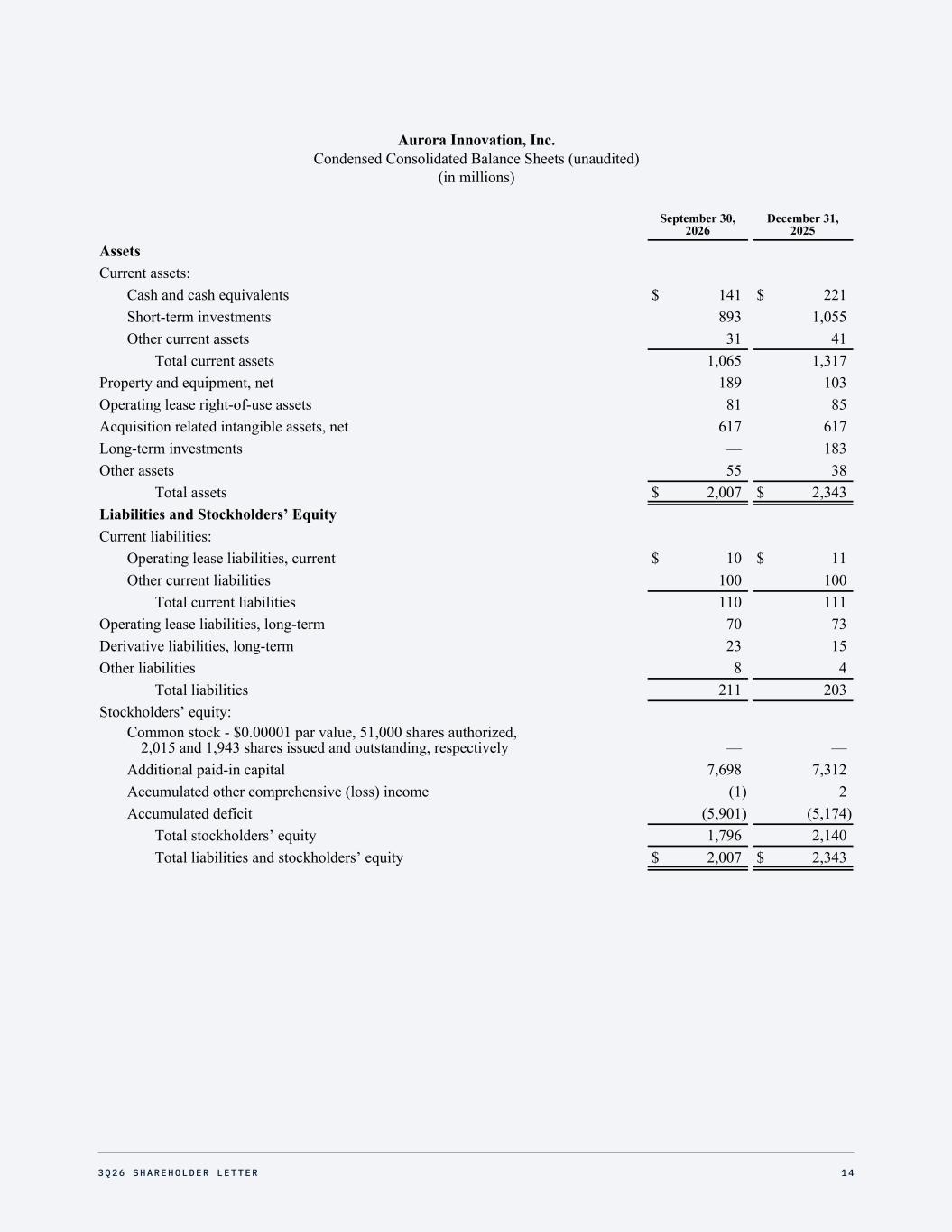
Aurora Innovation, Inc. Condensed Consolidated Balance Sheets (unaudited) (in millions) September 30, 2026 December 31, 2025 Assets Current assets: Cash and cash equivalents $ 141 $ 221 Short-term investments 893 1,055 Other current assets 31 41 Total current assets 1,065 1,317 Property and equipment, net 189 103 Operating lease right-of-use assets 81 85 Acquisition related intangible assets, net 617 617 Long-term investments — 183 Other assets 55 38 Total assets $ 2,007 $ 2,343 Liabilities and Stockholders’ Equity Current liabilities: Operating lease liabilities, current $ 10 $ 11 Other current liabilities 100 100 Total current liabilities 110 111 Operating lease liabilities, long-term 70 73 Derivative liabilities, long-term 23 15 Other liabilities 8 4 Total liabilities 211 203 Stockholders’ equity: Common stock - $0.00001 par value, 51,000 shares authorized, 2,015 and 1,943 shares issued and outstanding, respectively — — Additional paid-in capital 7,698 7,312 Accumulated other comprehensive (loss) income (1) 2 Accumulated deficit (5,901) (5,174) Total stockholders’ equity 1,796 2,140 Total liabilities and stockholders’ equity $ 2,007 $ 2,343 143Q26 SHAREHOLDER LETTER
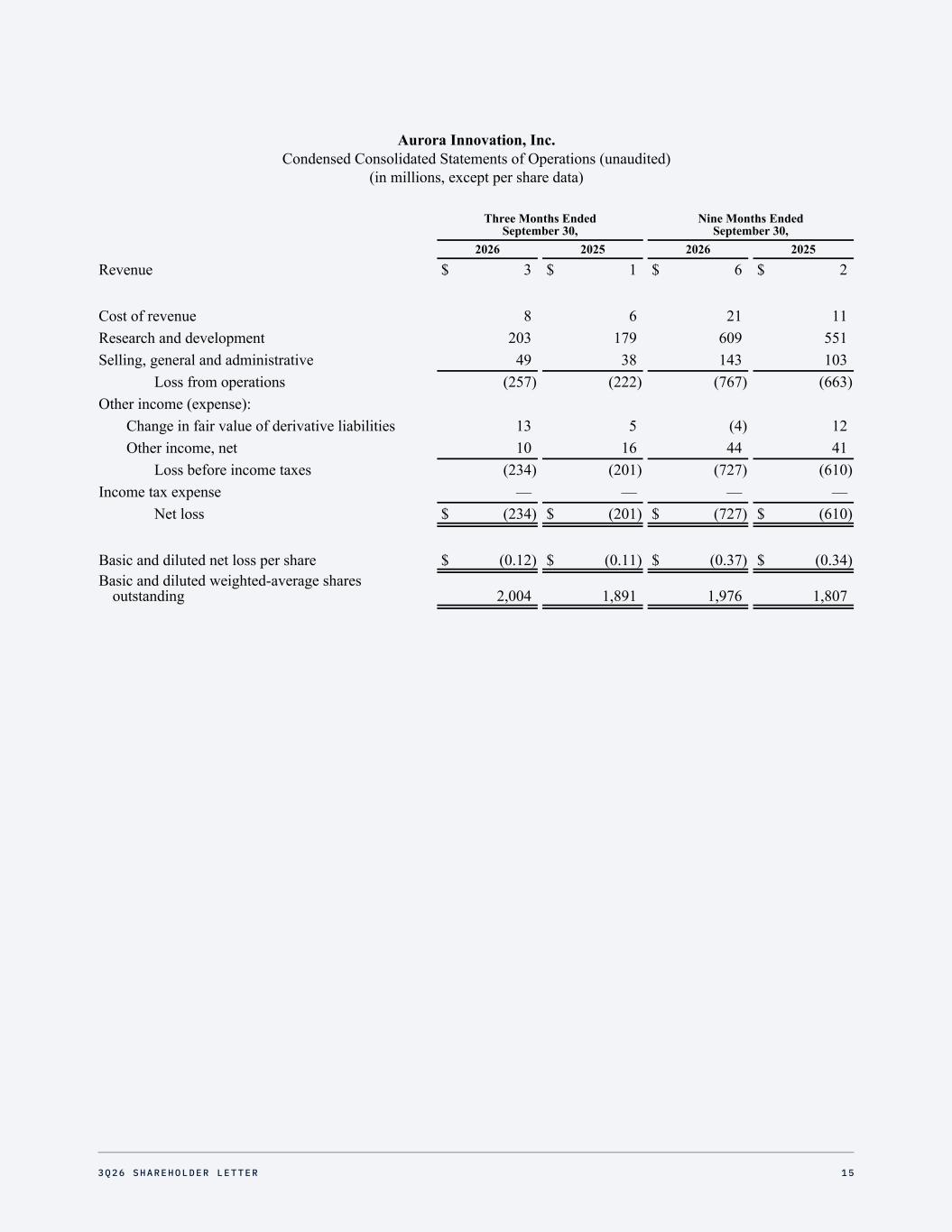
Aurora Innovation, Inc. Condensed Consolidated Statements of Operations (unaudited) (in millions, except per share data) Three Months Ended September 30, Nine Months Ended September 30, 2026 2025 2026 2025 Revenue $ 3 $ 1 $ 6 $ 2 Cost of revenue 8 6 21 11 Research and development 203 179 609 551 Selling, general and administrative 49 38 143 103 Loss from operations (257) (222) (767) (663) Other income (expense): Change in fair value of derivative liabilities 13 5 (4) 12 Other income, net 10 16 44 41 Loss before income taxes (234) (201) (727) (610) Income tax expense — — — — Net loss $ (234) $ (201) $ (727) $ (610) Basic and diluted net loss per share $ (0.12) $ (0.11) $ (0.37) $ (0.34) Basic and diluted weighted-average shares outstanding 2,004 1,891 1,976 1,807 153Q26 SHAREHOLDER LETTER
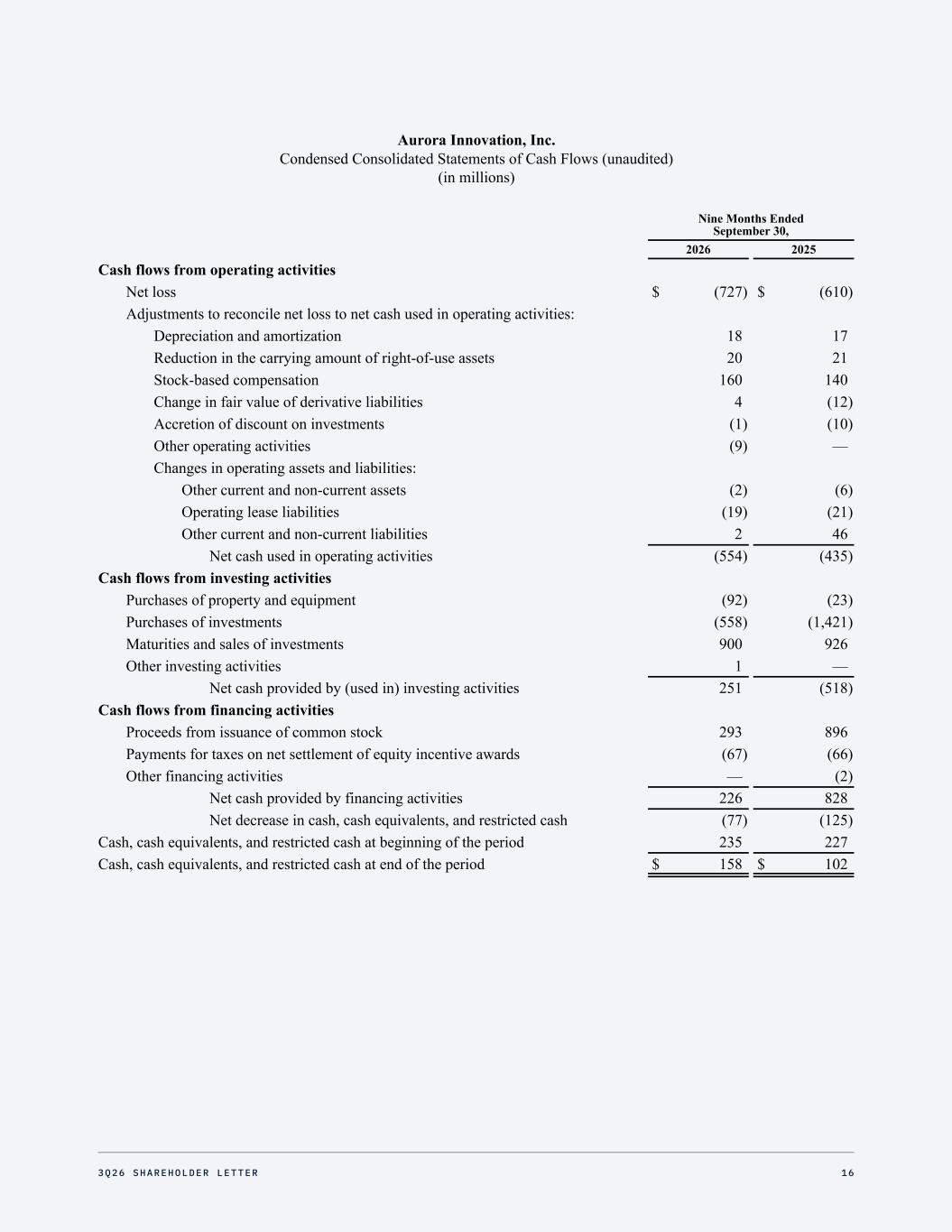
Aurora Innovation, Inc. Condensed Consolidated Statements of Cash Flows (unaudited) (in millions) Nine Months Ended September 30, 2026 2025 Cash flows from operating activities Net loss $ (727) $ (610) Adjustments to reconcile net loss to net cash used in operating activities: Depreciation and amortization 18 17 Reduction in the carrying amount of right-of-use assets 20 21 Stock-based compensation 160 140 Change in fair value of derivative liabilities 4 (12) Accretion of discount on investments (1) (10) Other operating activities (9) — Changes in operating assets and liabilities: Other current and non-current assets (2) (6) Operating lease liabilities (19) (21) Other current and non-current liabilities 2 46 Net cash used in operating activities (554) (435) Cash flows from investing activities Purchases of property and equipment (92) (23) Purchases of investments (558) (1,421) Maturities and sales of investments 900 926 Other investing activities 1 — Net cash provided by (used in) investing activities 251 (518) Cash flows from financing activities Proceeds from issuance of common stock 293 896 Payments for taxes on net settlement of equity incentive awards (67) (66) Other financing activities — (2) Net cash provided by financing activities 226 828 Net decrease in cash, cash equivalents, and restricted cash (77) (125) Cash, cash equivalents, and restricted cash at beginning of the period 235 227 Cash, cash equivalents, and restricted cash at end of the period $ 158 $ 102 163Q26 SHAREHOLDER LETTER
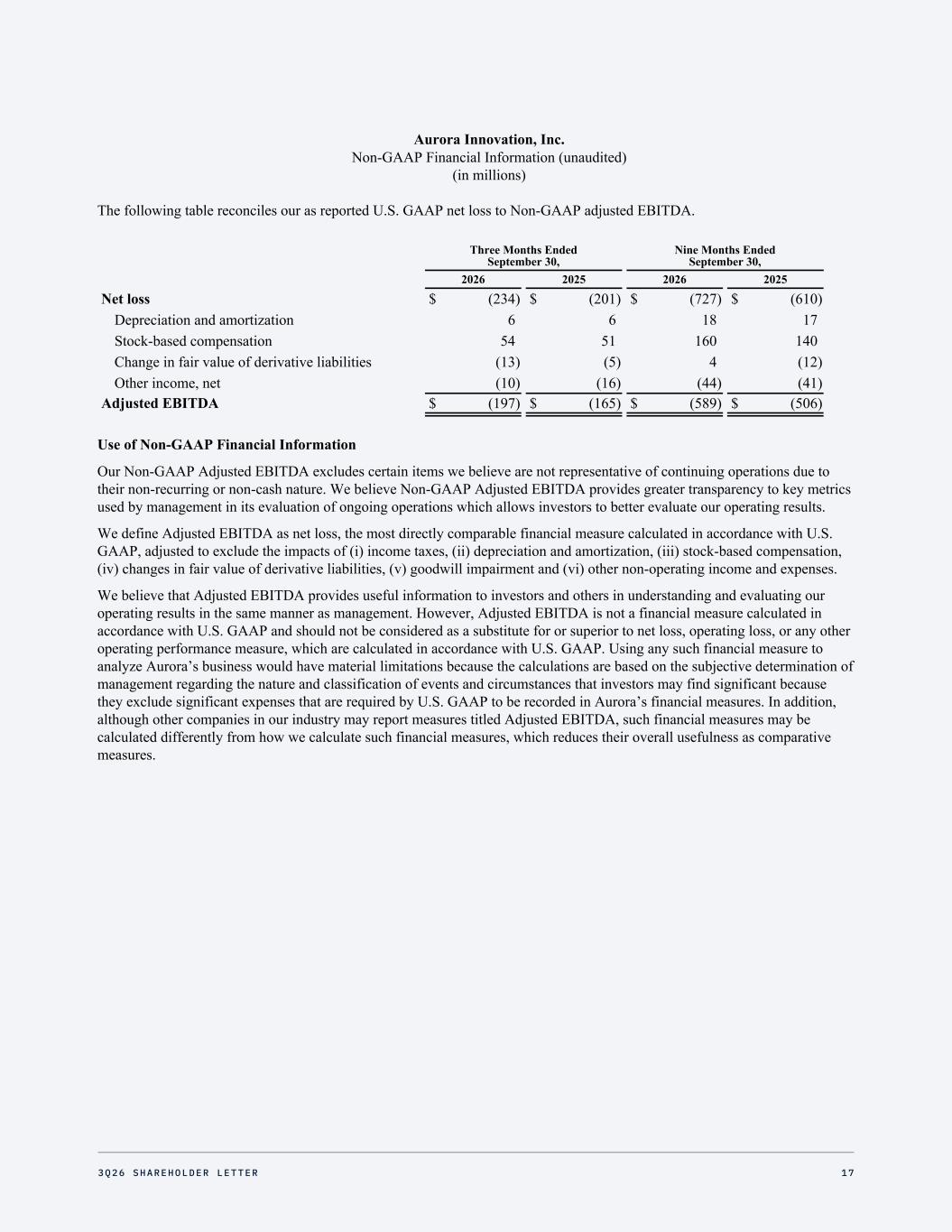
Aurora Innovation, Inc. Non-GAAP Financial Information (unaudited) (in millions) The following table reconciles our as reported U.S. GAAP net loss to Non-GAAP adjusted EBITDA. Three Months Ended September 30, Nine Months Ended September 30, 2026 2025 2026 2025 Net loss $ (234) $ (201) $ (727) $ (610) Depreciation and amortization 6 6 18 17 Stock-based compensation 54 51 160 140 Change in fair value of derivative liabilities (13) (5) 4 (12) Other income, net (10) (16) (44) (41) Adjusted EBITDA $ (197) $ (165) $ (589) $ (506) Use of Non-GAAP Financial Information Our Non-GAAP Adjusted EBITDA excludes certain items we believe are not representative of continuing operations due to their non-recurring or non-cash nature. We believe Non-GAAP Adjusted EBITDA provides greater transparency to key metrics used by management in its evaluation of ongoing operations which allows investors to better evaluate our operating results. We define Adjusted EBITDA as net loss, the most directly comparable financial measure calculated in accordance with U.S. GAAP, adjusted to exclude the impacts of (i) income taxes, (ii) depreciation and amortization, (iii) stock-based compensation, (iv) changes in fair value of derivative liabilities, (v) goodwill impairment and (vi) other non-operating income and expenses. We believe that Adjusted EBITDA provides useful information to investors and others in understanding and evaluating our operating results in the same manner as management. However, Adjusted EBITDA is not a financial measure calculated in accordance with U.S. GAAP and should not be considered as a substitute for or superior to net loss, operating loss, or any other operating performance measure, which are calculated in accordance with U.S. GAAP. Using any such financial measure to analyze Aurora’s business would have material limitations because the calculations are based on the subjective determination of management regarding the nature and classification of events and circumstances that investors may find significant because they exclude significant expenses that are required by U.S. GAAP to be recorded in Aurora’s financial measures. In addition, although other companies in our industry may report measures titled Adjusted EBITDA, such financial measures may be calculated differently from how we calculate such financial measures, which reduces their overall usefulness as comparative measures. 173Q26 SHAREHOLDER LETTER